National flagship · elite sport · innovation · entertainment · global gateway
BOTSWANA · NATIONAL SPORTS DEVELOPMENT PLATFORM
Building sports cities,
not isolated venues.
A national portfolio of mixed-use, multi-code and multidisciplinary master-planned communities integrating sport, science, education, technology, industry, entertainment, tourism, real estate, aviation and mobility.
13Integrated developments
3Flagship Sports Cities
10Regional hubs
13Masterplan systems
OVERVIEW / 01FROM VENUES TO DESTINATIONS
THE DEVELOPMENT THESIS
Sport becomes the urban anchor for a complete economic ecosystem.
Bretton Sports develops master-planned sporting communities where competition venues are integrated with education, sports science, software, industry, commerce, tourism, residential development, aviation, golf, canals and multimodal transport.
01Mixed-use by design
Every destination combines sport with complementary economic and urban uses.
02Multi-code by default
Competition, participation, training and high-performance infrastructure across disciplines.
03365-day activation
Commercial, education, leisure, tourism and residential uses sustain activity beyond event days.
04Networked nationally
Three flagship cities and ten regional hubs operate as one Botswana sports development system.
BRETTONSPORTS CITYINTEGRATED DEVELOPMENT OS
SPORT
SCIENCE
EDUCATION
TECHNOLOGY
INDUSTRY
TOURISM
REAL ESTATE
MOBILITY
OVERVIEW / 02NATIONAL PORTFOLIO ARCHITECTURE
BOTSWANA SPORTS NETWORK
Three flagship cities.
Three flagship cities.
Ten regional hubs.
One national system.
The portfolio is deliberately distributed: destination-scale sports cities anchor national and regional competition while district hubs expand access, talent pathways, community participation and local economic activation.
0FLAGSHIP SPORTS CITIES
0REGIONAL HUBS
0INTEGRATED DEVELOPMENTS
0COMMON CITY SYSTEMS
Northern gateway · COSAFA platform · smart stadium · sports & entertainment district
Sport × tourism · golf · hospitality · premium destination experiences
Modular regional sport, education, entertainment and community development platforms
OVERVIEW / 03INTEGRATED CITY OPERATING SYSTEM
13 MASTERPLAN SYSTEMSA city built around sport—
A city built around sport—
not a stadium surrounded by parking.
Every Bretton Sports destination is composed from a common modular system. The scale and mix change by location; the integration logic remains constant.
SPORTS
CITY
SPORTEDUCATIONSCIENCE + R&DSOFTWAREINDUSTRYCOMMERCIALLEISURERESIDENTIALAIRFIELDTRANSPORTCANALSGOLFUTILITIESCITY
OVERVIEW / 04MULTIDISCIPLINARY SPORTING PLATFORM
MULTI-CODE BY DESIGN
From grassroots participation to international competition.
The sporting core is deliberately configurable by city and hub, allowing Bretton Sports to combine large spectator codes, specialist disciplines, indoor sport, community participation and high-performance training.
COMMUNITYDEVELOPMENTACADEMYHIGH PERFORMANCEPROFESSIONALINTERNATIONAL
OVERVIEW / 05CONNECTED DESTINATION INFRASTRUCTURE
CITY-SCALE CONNECTIVITY
Move spectators, residents, teams and visitors as one integrated network.
Mobility is treated as a core development system. Each flagship city combines mass transit, active mobility, premium aviation and water-based movement around a structured canal and public-realm network.
0CANAL BRIDGES / CITY
PRIVATE PREMIUM AIRFIELDExecutive · teams · charter · air taxi
OVERVIEW / 06THE SPORTS ECONOMY ENGINE
365-DAY VALUE CREATIONEvent days start the economy.
Event days start the economy.
District life sustains it.
The city model compounds event revenue with education, research, technology, manufacturing, hospitality, commercial leasing, tourism, residential real estate and mobility.
SPORT
EVENTSMEDIATECHR&DEDUCATIONINDUSTRYTOURISMREAL ESTATE
EVENT ECONOMYCompetition + Entertainment
KNOWLEDGE ECONOMYEducation + Science + Software
INDUSTRIAL ECONOMYEquipment + Technology + Manufacturing
PROPERTY ECONOMYCommercial + Hospitality + Residential + Golf
OVERVIEW / 07REFERENCE PILOT / FRANCISTOWN
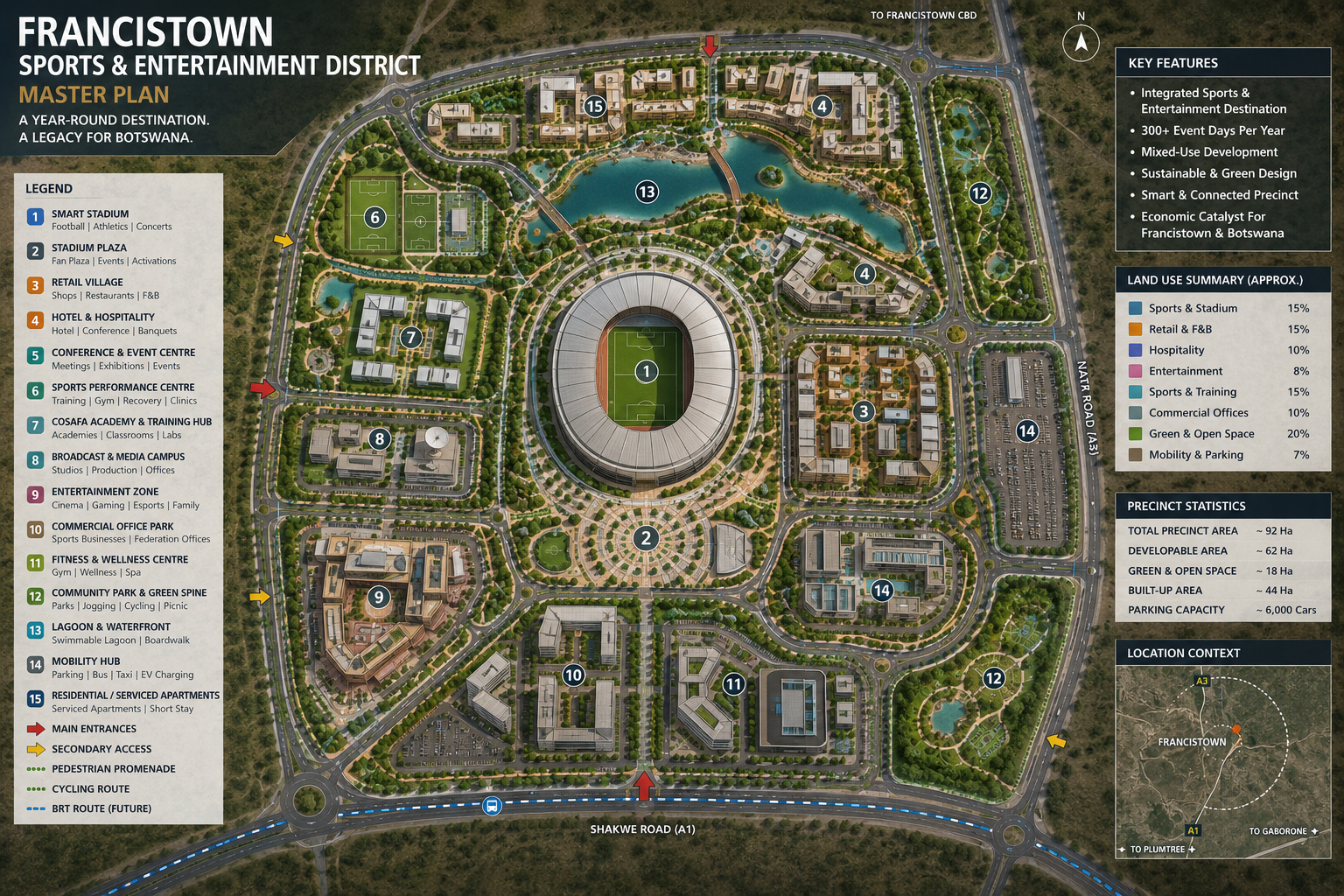
FSC / SMART STADIUM PILOT
PROVE → STANDARDISE → REPLICATE
Explore the flagship cities
Francistown establishes the first reference architecture.
The Francistown Sports & Entertainment District is positioned as a practical pilot for smart-stadium digitalisation, mixed-use precinct development and COSAFA-ready operations before broader national and regional replication.
01Smart Stadium
02Mixed-Use District
03Digital Operations
04Regional Replication
13 developments.
One integrated sporting nation.
Enter the national portfolio ↓PORTFOLIO / 01NATIONAL DEVELOPMENT PORTFOLIO
13 INTEGRATED DESTINATIONS
A national portfolio of sports cities, districts and regional hubs.
Bretton Sports develops an interconnected national system rather than a collection of isolated venues. Every project is calibrated to its market, catchment and tourism context while sharing a common mixed-use development architecture.
0Developments
0Flagship cities
0Regional hubs
0Shared city systems
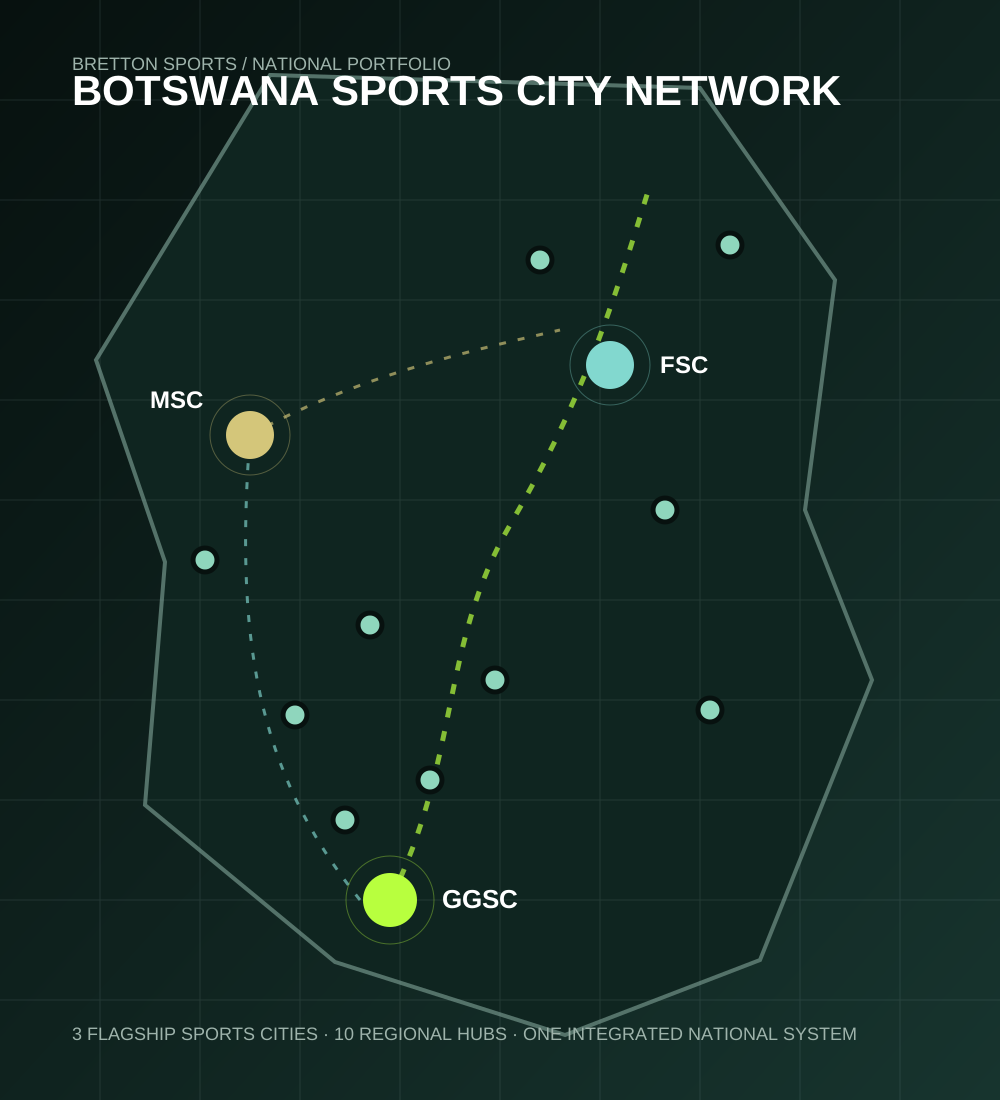
GGSC / NATIONAL FLAGSHIP
FSC / NORTHERN GATEWAY
MSC / TOURISM DESTINATION
PORTFOLIO MODEL3 + 10flagship + regional
DEVELOPMENT TYPEMIXED-USEsport-led urban systems
SPORTING MODELMULTI-CODEcompetition → community
ECONOMIC MODEL365 DAYSevent + knowledge + property
NETWORK MODELNATIONALlinked talent + mobility system
PORTFOLIO / 02NATIONAL NETWORK & CORRIDOR LOGIC
ONE NATIONAL SYSTEM
01
02
03
04
Flagship destinations anchor regional participation and talent corridors.
The portfolio combines three destination-scale urban developments with ten modular regional hubs. The objective is national coverage across elite competition, academies, community participation, tourism, entertainment, sports science and commercial activity.
Southern / Capital CorridorGGSC anchors national competition, innovation, commercialisation and international events.
Northern / COSAFA CorridorFSC anchors northern Botswana and the Francistown smart-stadium reference platform.
Tourism / Leisure CorridorMSC integrates sport with Maun's hospitality, leisure, golf and northern tourism economy.
District Access NetworkTen hubs distribute facilities, talent pathways, education and local economic activation.
PORTFOLIO / 03FLAGSHIP SPORTS CITIES
DESTINATION-SCALE DEVELOPMENT
Three cities. Three differentiated strategic propositions.
Each flagship carries the complete Bretton Sports city architecture while being programmed around a distinct market role.
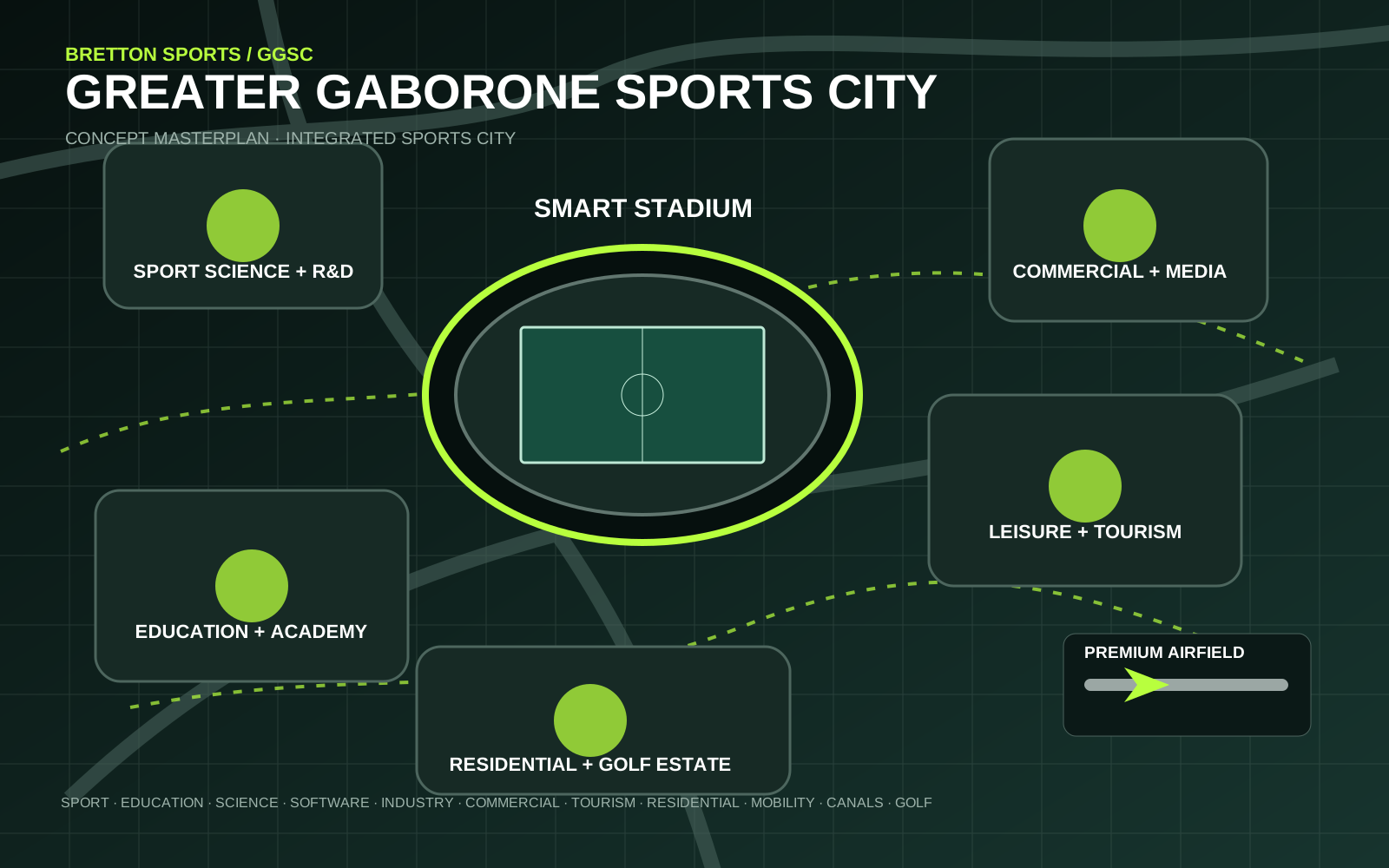
National anchor for elite sport, global competitions, sports science, technology, industry, commercial activity and premium real estate.
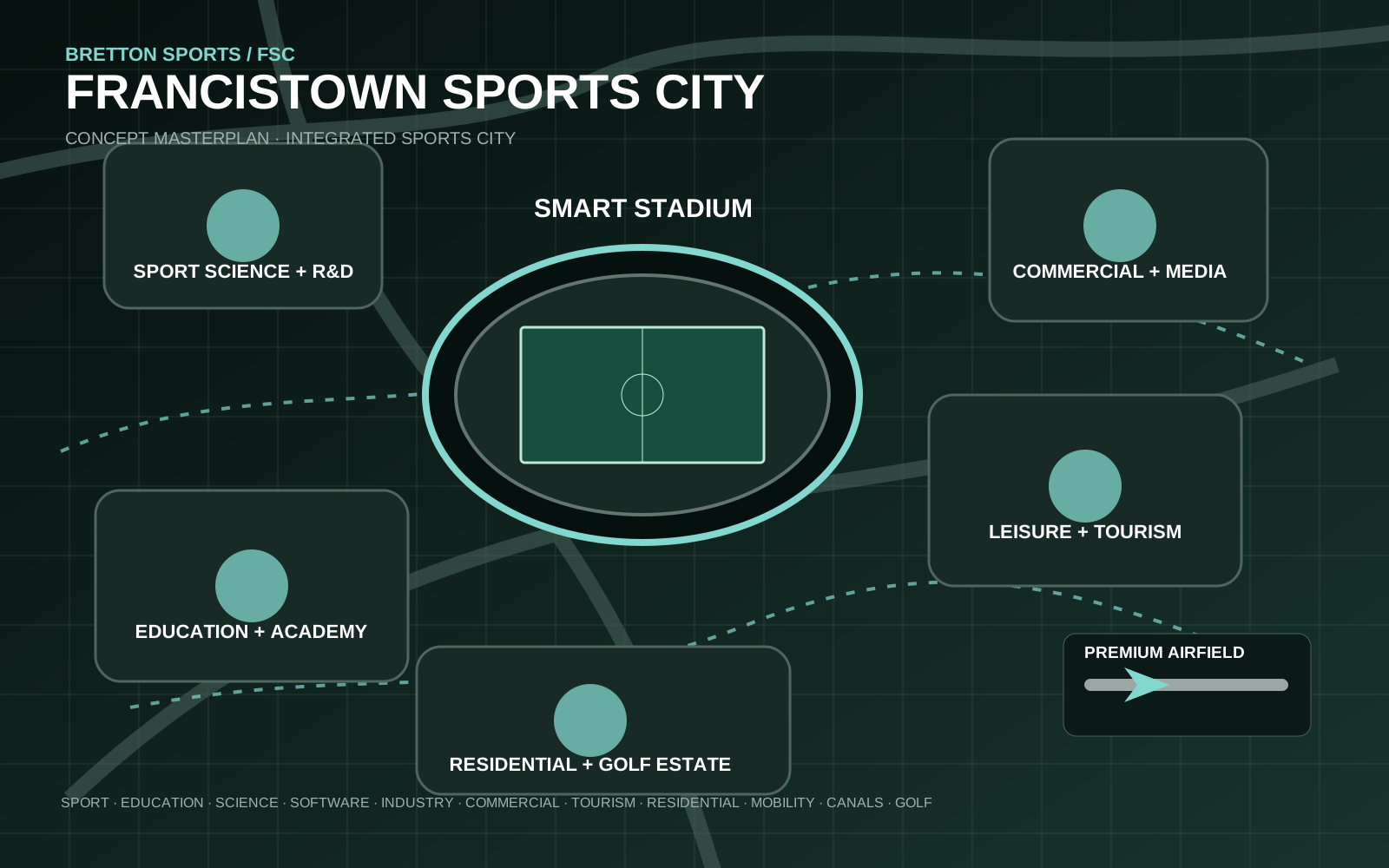
Northern sporting and entertainment gateway anchored by the Francistown Smart Stadium and mixed-use Sports & Entertainment District.
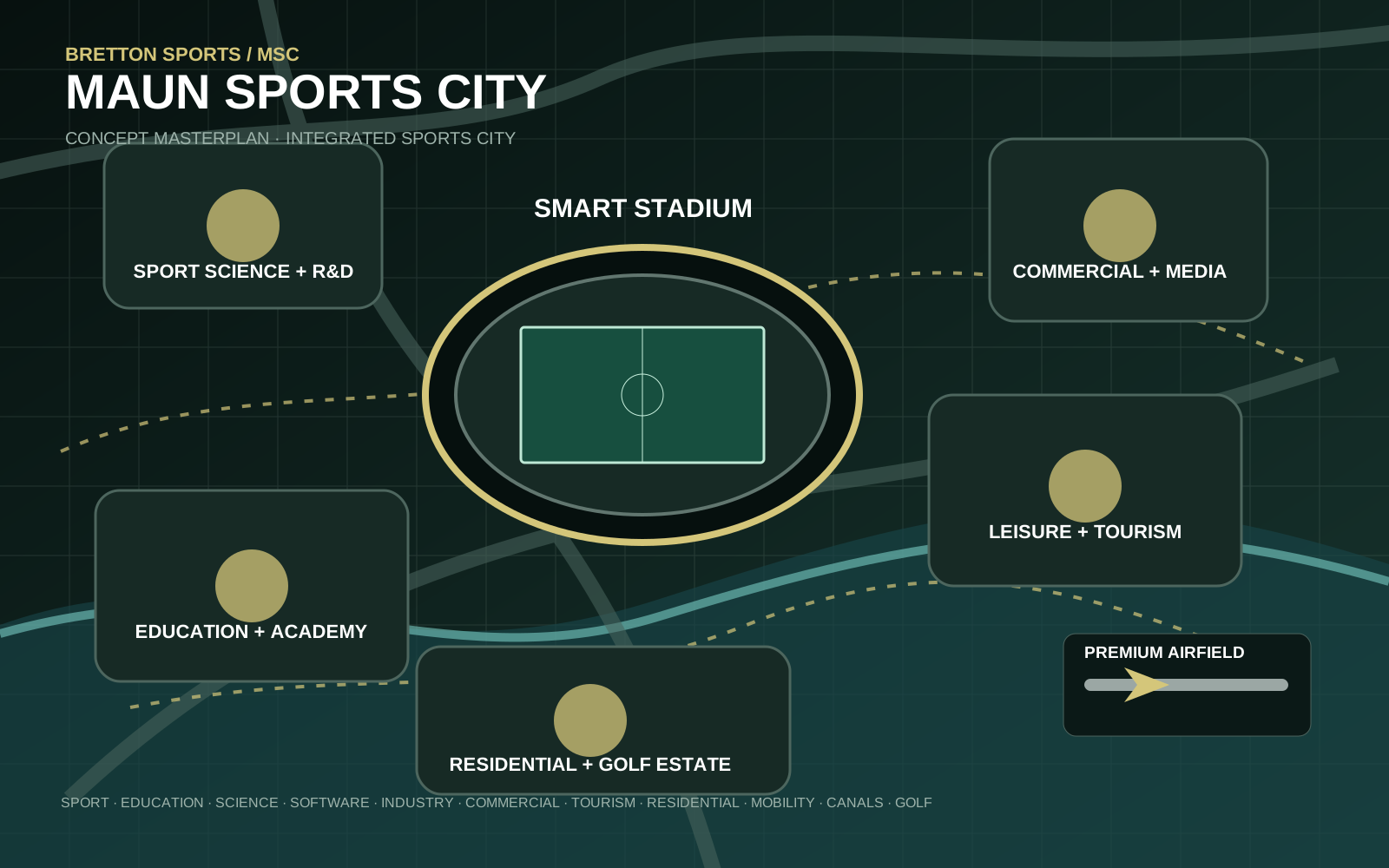
Sport-led destination integrated with hospitality, golf, canals, premium aviation and Botswana's northern visitor economy.
FLAGSHIP COMPARISON MATRIXCONTROLLED DEVELOPMENT POSITIONING
SystemGGSCFSCMSC
Primary RoleNational / GlobalNorthern / COSAFATourism / Leisure
Smart Stadium●●●
Sports Science + R&D●●●●●●●
Sports Industry + Software●●●●●●
Tourism + Hospitality●●●●●●●
Golf Estate●●●●●●●
Premium Airfield●●●
Integrated TransitLRT · BRT · MRTLRT · BRTBRT · Water/Air Taxi
PORTFOLIO / 04TEN REGIONAL SPORTING & ENTERTAINMENT HUBS
MODULAR REGIONAL DEVELOPMENT
Local access. Regional competition. National connectivity.
The ten hubs use the same city-system logic at a scalable district level, with programme intensity based on catchment and economic role.
PORTFOLIO / 05COMMON DEVELOPMENT SYSTEM
SHARED ARCHITECTURE
Every destination is assembled from 13 interoperable systems.
This creates a standardised development language while allowing each project to adapt its density, code mix and commercial emphasis.
PORTFOLIO / 06DEVELOPMENT PIPELINE & PORTFOLIO CONTROL
END-TO-END DEVELOPMENT
Portfolio control from concept through operations.
The portfolio view connects each destination to the Bretton Sports development system, enabling projects to move through common controlled gates while retaining individual masterplans and commercial strategies.
PORTFOLIO13controlled developments
FLAGSHIPS3destination-scale anchors
REGIONAL10modular hubs
GATES11development stages
PortfolioConceptMasterplanFeasibilityApprovalsDesignCommercialFundingProcurementConstructionOperations
BRETTON SPORTS / NATIONAL PORTFOLIO
From three flagship cities to a country-wide sports economy network.
Enter Sports Cities →
Sports Cities
Positioning
National Network
GGSC
FSC
MSC
City OS
Sporting Assets
Knowledge
Mixed-Use Districts
Mobility
Digital Twin
Sustainability
Phasing
Economy
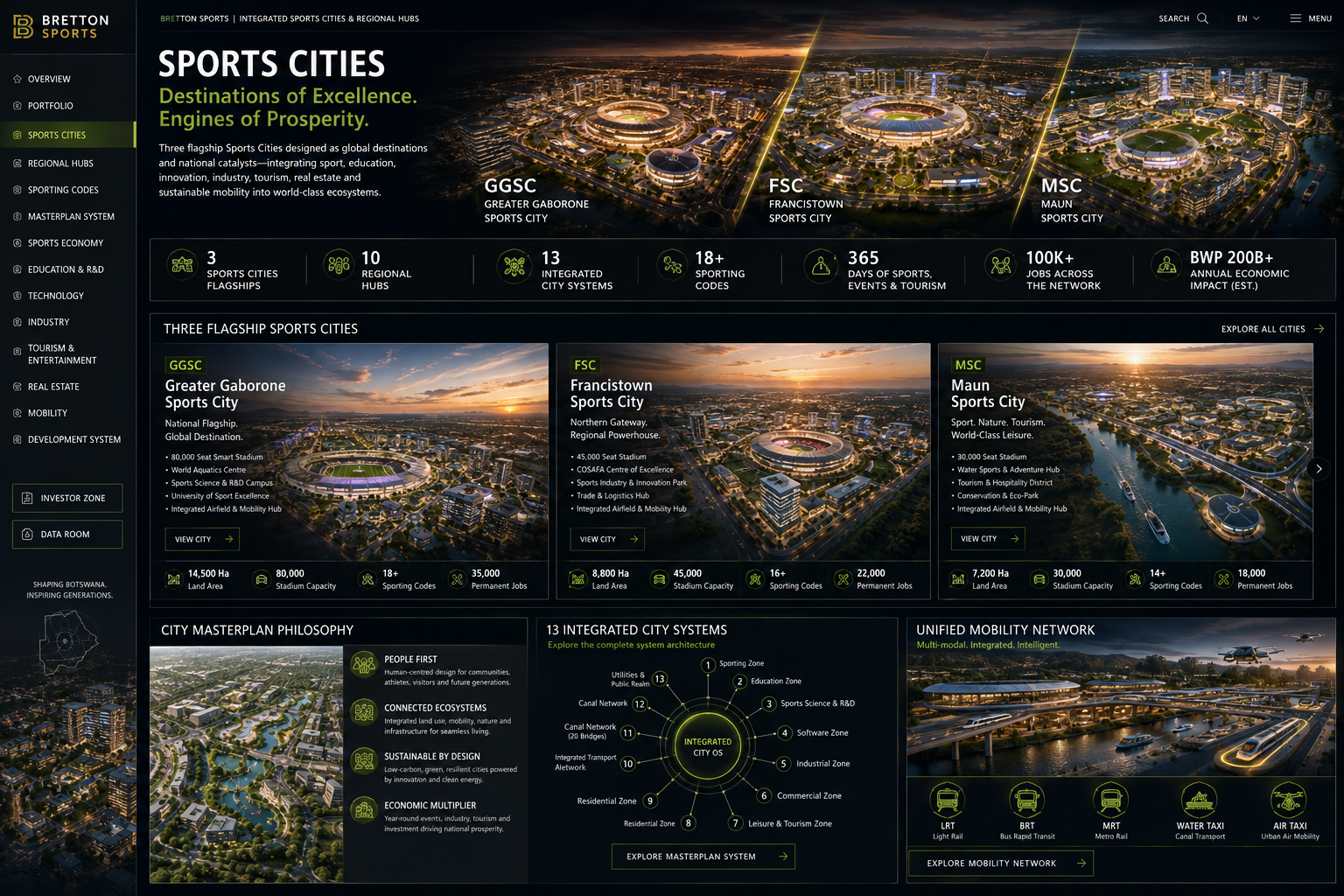
GGSCNational Flagship
FSCNorthern Gateway
MSCSport × Tourism
SPORTS CITIES / 01THREE FLAGSHIP DESTINATIONS
GREATER GABORONE · FRANCISTOWN · MAUN
Three destination-scale sports cities.
One national urban-development platform.
Bretton Sports develops its flagship cities as complete mixed-use economies. Each destination combines multidisciplinary sport, education, sports science and R&D, software, industry, commerce, leisure and tourism, premium residential districts, aviation, integrated mass transit, a 20-bridge canal network and golf.
0Flagship Cities
0Integrated Systems
0Sporting Codes+
0Canal Bridges / City
0Transit Modes
0Day Destination Economy
SPORTS CITIES / 02STRATEGIC POSITIONING
ONE DEVELOPMENT DNA · THREE DISTINCT MARKET ROLES
Each city is designed to win a different strategic position.
The integrated systems remain consistent, but scale, anchor assets, sporting mix, tourism proposition and commercial intensity are calibrated to the destination.
Global events, elite performance, innovation, sports industry, premium urban living and international connectivity.
Smart stadium, regional competitions, media, training, entertainment and northern trade and tourism connectivity.
Adventure sport, golf, wellness, destination hospitality, canal districts and premium tourism integration.
Strategic roleNational flagship
Primary marketBotswana + Southern Africa + global events
Anchor propositionElite sport + innovation + sports industry
Destination assetsStadium · arenas · aquatics · R&D · premium urban districts
Mobility emphasisFull multimodal metropolitan network
Distinctive edgeScale + global-event capability
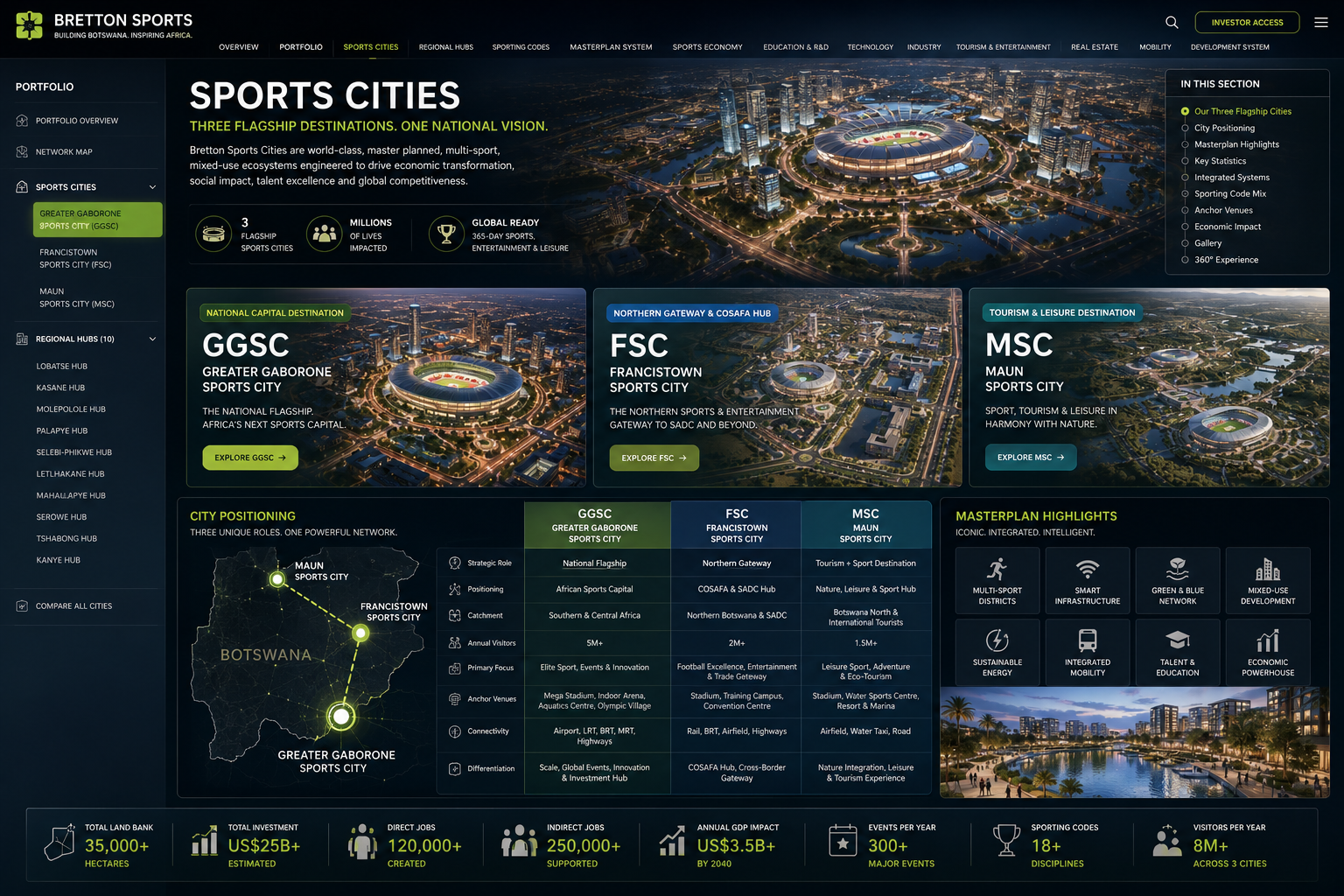 EXECUTIVE COMPARISON / THREE FLAGSHIP SPORTS CITIES
SPORTS CITIES / 03NATIONAL FLAGSHIP NETWORK
CONNECTED DESTINATIONS
GGSCCapital / national / international gatewayGLOBAL SPORT · R&D · INDUSTRY
FSCNorthern / COSAFA / cross-border gatewaySMART STADIUM · MEDIA · TRAINING
MSCTourism / leisure / premium visitor gatewayGOLF · WELLNESS · WATERFRONT
Three city economies connected to a national sporting network.
GGSC, FSC and MSC are designed as complementary national anchors. Talent, competitions, tourism, media, training, research and commercial activity move between the three cities and the wider ten-hub regional network.
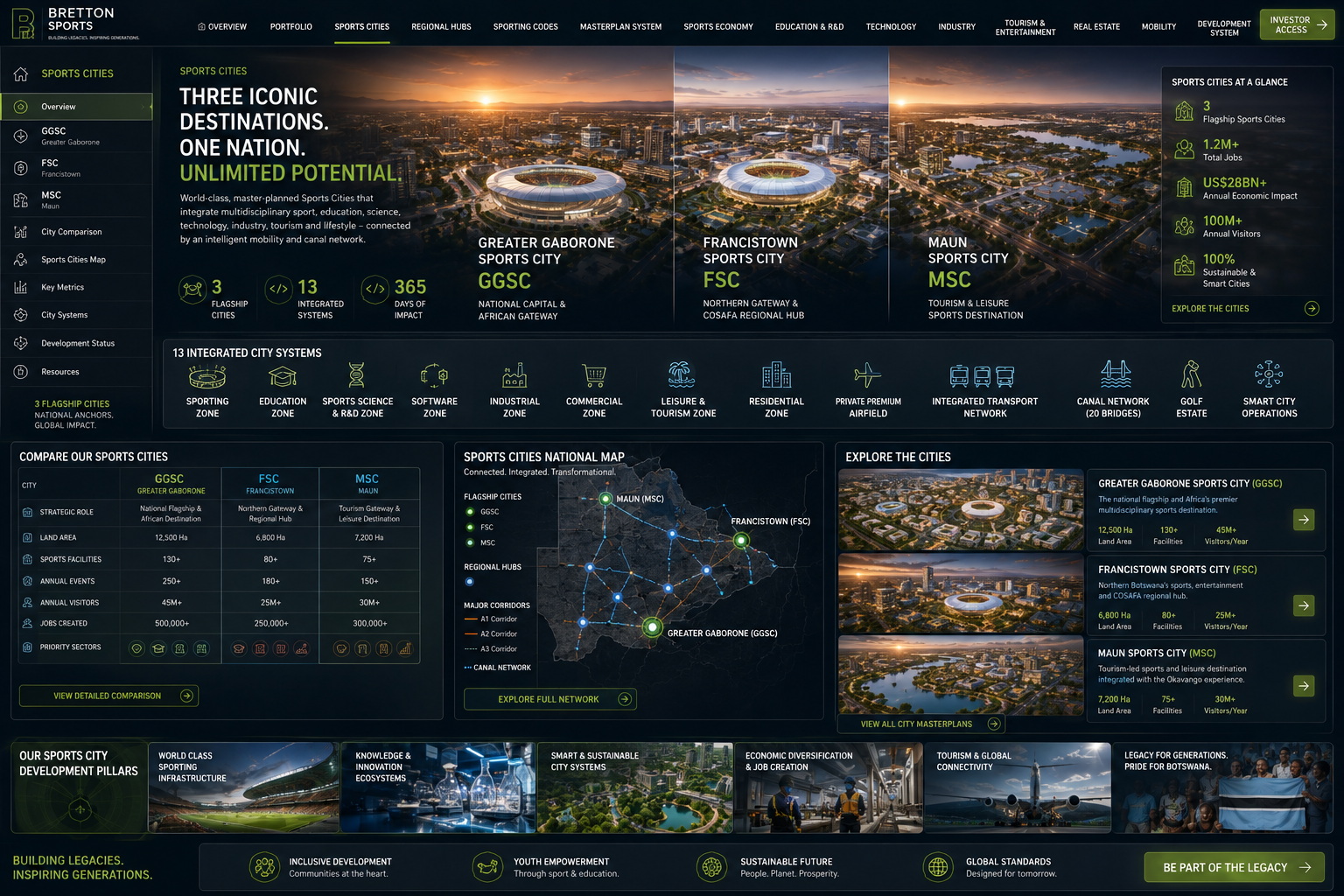
SPORTS CITIES / 04GREATER GABORONE SPORTS CITY
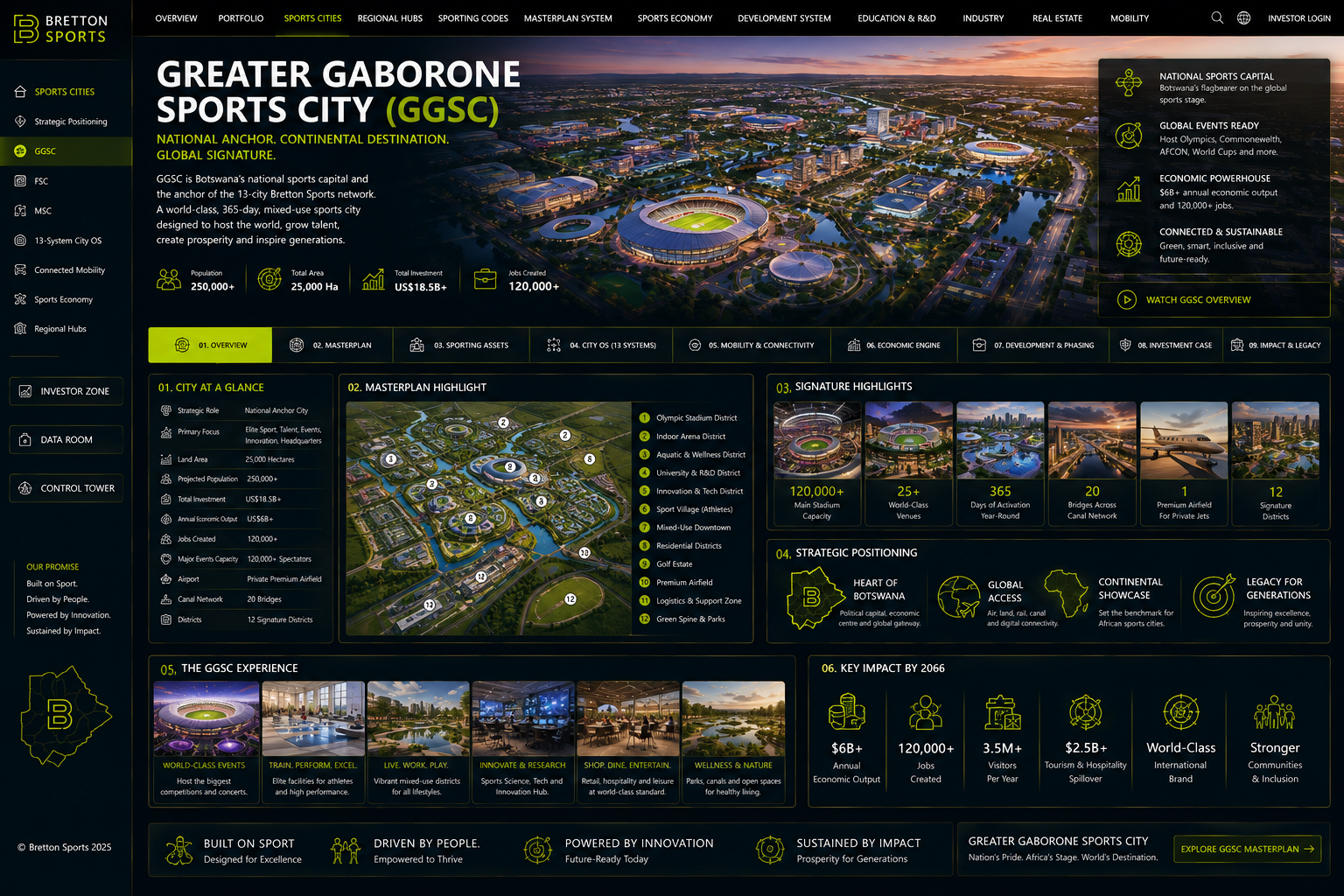
GGSC · NATIONAL FLAGSHIP SPORTS CITY
Greater Gaborone becomes a continental sports capital.
GGSC is the flagship Bretton Sports destination: a mixed-use, multi-code, knowledge-intensive Sports City integrating world-class venues, athlete development, education, science, software, industry, commerce, tourism, residential districts, premium aviation, mass transit, canals and golf into one operating urban system.
01 · VISION & POSITIONING
A city built around performance, participation and prosperity.
GGSC is conceived as both national infrastructure and a destination economy. Its purpose is to create the environment in which athletes can train and compete, students can learn, researchers can innovate, businesses can build, visitors can stay, and residents can live within a connected sports-led urban ecosystem.
02 · MASTERPLANOne flagship city.
One flagship city.
Thirteen integrated systems.
The GGSC masterplan uses the common Bretton Sports City OS, but at metropolitan flagship scale. Sport remains the anchor, while every other zone is designed to amplify participation, knowledge creation, visitor spending, enterprise activity and year-round urban life.
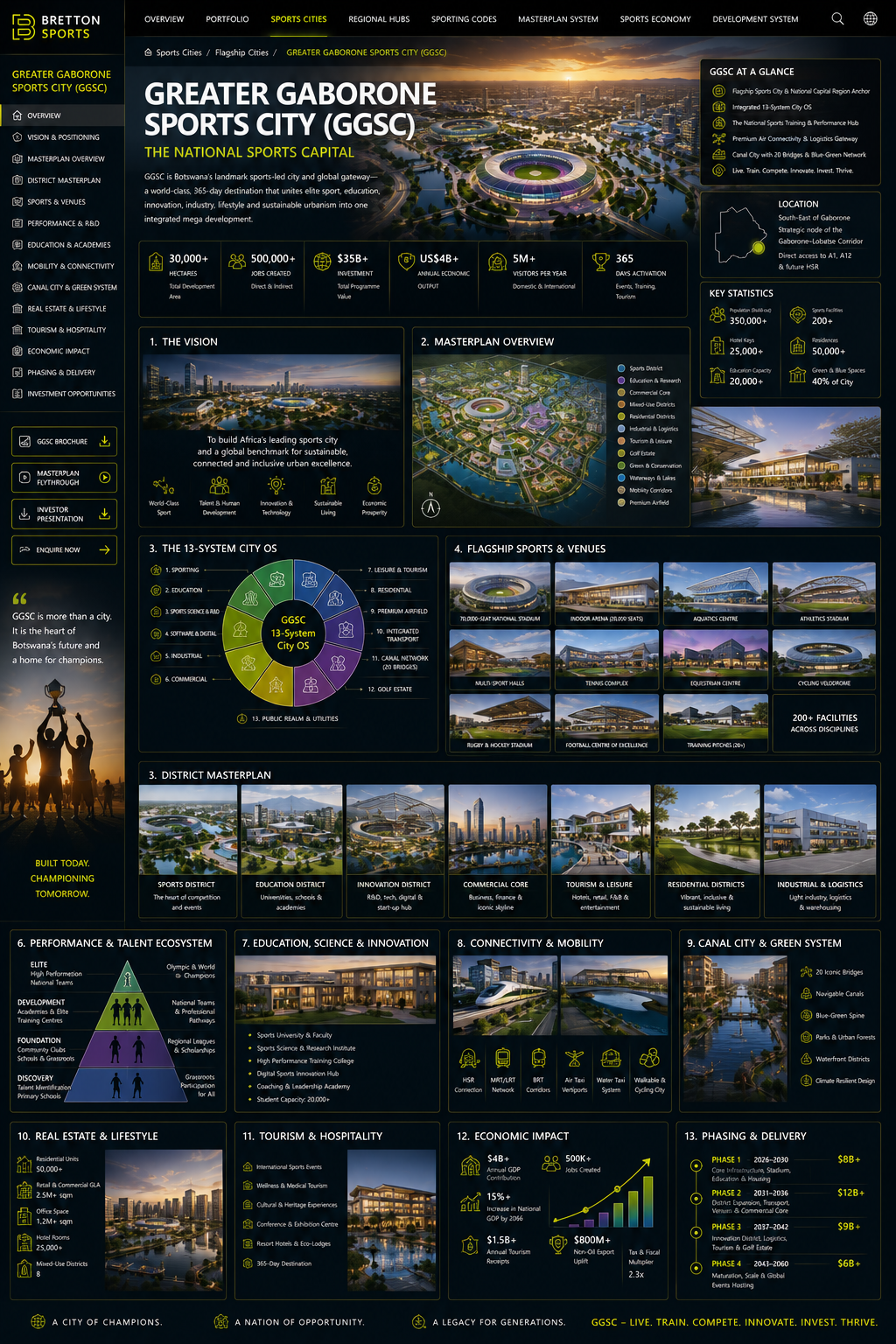
03 · SPORTING DISTRICTFrom community participation
From community participation
to global competition.
The Sporting Zone is planned as a family of interoperable venues rather than a single stadium precinct, supporting competition, daily training, academies, community programmes, events and professional sport.
Major football, athletics, ceremonies, concerts and international events.
Basketball, netball, combat sports, gymnastics, entertainment and exhibitions.
Competition pools, diving, training, recovery and community aquatic programmes.
Training pitches, athlete services, strength and conditioning and recovery.
Rugby, cricket, tennis, hockey, cycling, volleyball and adaptable sports halls.
Universal access, community fields and structured inclusive participation.
FootballAthleticsRugbyCricketBasketballNetballTennisAquaticsCyclingGymnasticsCombat SportsGolfMotorsportEsportsHockeyVolleyballPara SportAdditional Codes
04 · PERFORMANCE & TALENTA national pathway engineered
A national pathway engineered
for continuous athlete progression.
GGSC sits at the top of the Bretton Sports talent network, receiving athletes from community programmes, schools, regional hubs and elite academies while feeding national teams and professional pathways.
05 · EDUCATION · SCIENCE · SOFTWARE
The city develops knowledge as aggressively as athletes.
Education and R&D are treated as productive city infrastructure. The objective is to connect schools, academies, universities, laboratories, sports medicine, performance analytics and digital product development to the sporting economy.
Sports management, coaching, medicine, engineering, media, hospitality and business pathways.
Biomechanics, physiology, performance analytics, recovery, nutrition and injury prevention.
AI, data, fan platforms, Digital Twin, venue systems, media technology and athlete applications.
Equipment testing, materials, wearables, smart surfaces, sensor systems and applied research.
06 · SPORTS ECONOMYA 365-day urban economy
A 365-day urban economy
with sport as the demand engine.
GGSC is designed to create value before, during and after events. The economic model extends from construction and venue operations into tourism, property, media, retail, education, technology, manufacturing and professional services.
07 · MOBILITY & CONNECTIVITYMove athletes, residents and visitors
Move athletes, residents and visitors
as one integrated network.
The flagship city is planned around a multimodal mobility hierarchy linking Greater Gaborone, internal districts, event venues, hospitality zones, the premium airfield and the canal network.
Primary urban circulation spine.
High-frequency district and event services.
Long-term high-capacity metropolitan backbone.
Waterfront leisure and destination connectivity.
Premium point-to-point regional access.
Business aviation, teams, VIP and aero-services.
08 · CANAL CITY & BLUE-GREEN NETWORKInfrastructure becomes
20signature bridges 1connected canal network 365day public realm 4functions: mobility · leisure · ecology · value
Infrastructure becomes
public realm.
The canal system is more than a visual amenity. It is conceived as a connected blue-green framework combining water management, public space, leisure, waterfront development, active mobility and water-taxi operations.
SPORTHOSPITALITYRESIDENTIALGOLFCOMMERCIAL
09 · REAL ESTATE · TOURISM · LIFESTYLENot a venue precinct.
Not a venue precinct.
A complete destination city.
The mixed-use programme is intended to keep GGSC active outside matchdays through housing, offices, retail, hospitality, dining, wellness, golf, events, waterfront experiences and premium visitor accommodation.
Apartments, townhouses, premium residences and serviced living.
Team hotels, premium accommodation, MICE and event hospitality.
Sports retail, offices, dining, entertainment and enterprise space.
Championship golf, clubs, promenades, wellness and canal-front leisure.
10 · DIGITAL TWIN & CITY OPERATIONSPlan digitally.
Plan digitally.
Operate intelligently.
Optimise continuously.
A GGSC Digital Twin connects planning, construction and operations data across venues, mobility, utilities, security, public realm, commercial districts and visitor systems.
GISBIM / CDEIoTAI AnalyticsVenue OperationsMobilityEnergy & WaterSecurityAsset ManagementFan & Visitor Data
GGSC / LIVE CITY MODELvenues · districts · mobility · utilities · assets
11 · PHASING & DELIVERY
Build the city in operable economic layers.
GGSC should be delivered as a sequence of investable districts and enabling systems. Each phase should create operating capability and commercial activation rather than waiting for the entire city to be complete.
GREATER GABORONE SPORTS CITY / GGSCLive. Train. Compete.
Live. Train. Compete.
Innovate. Invest. Thrive.
GGSC is the national flagship expression of the Bretton Sports model: a sports-led city built to develop champions, create industries, attract visitors, grow communities and establish a durable national sporting legacy.
SPORTS CITIES / 05FRANCISTOWN SPORTS CITY
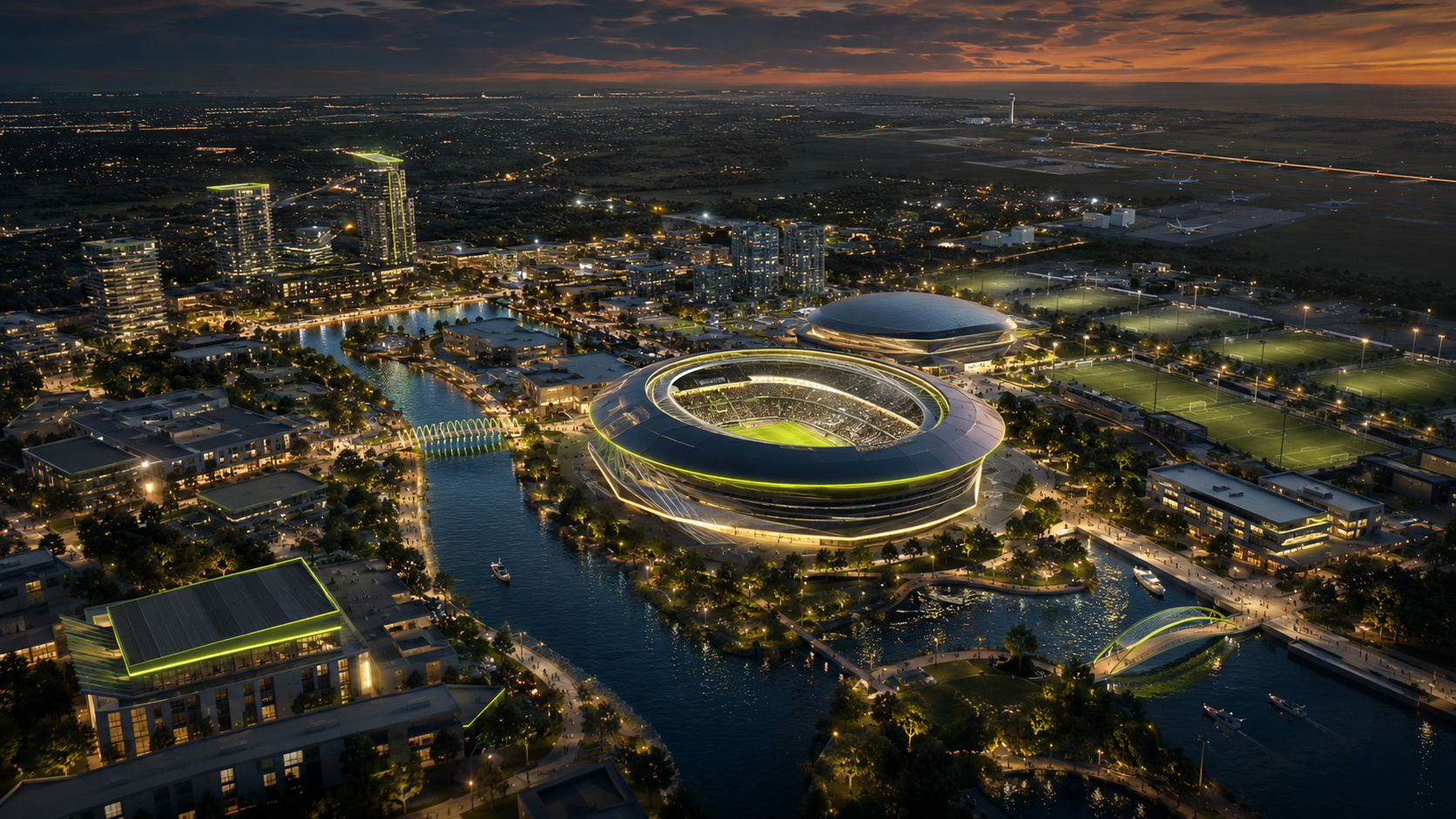
FSC · NORTHERN GATEWAY · COSAFA PLATFORM
Francistown becomes Botswana's regional sports, media and entertainment capital.
FSC transforms the Francistown Smart Stadium pilot into a complete mixed-use Sports City. It is designed to anchor COSAFA-ready tournament infrastructure, smart-stadium operations, talent development, sports science, broadcasting, hospitality, waterfront districts, premium aviation and a year-round northern Botswana destination economy.
01 · VISION & POSITIONING
A city built to host, train, produce and connect.
FSC is the northern flagship expression of Bretton Sports. It combines sport, training, media, commerce, tourism and urban development in a city model that can host regional tournaments, develop talent, generate jobs and establish Francistown as a cross-border sports and entertainment gateway.
02 · MASTERPLANOne Sports City.
One Sports City.
Thirteen integrated systems.
The FSC masterplan applies the Bretton Sports City OS to Francistown's specific role as a smart-stadium, sports-media and tournament-hosting platform. Sport is the anchor, but the surrounding districts capture value through learning, enterprise, hospitality, residential growth and connected public realm.
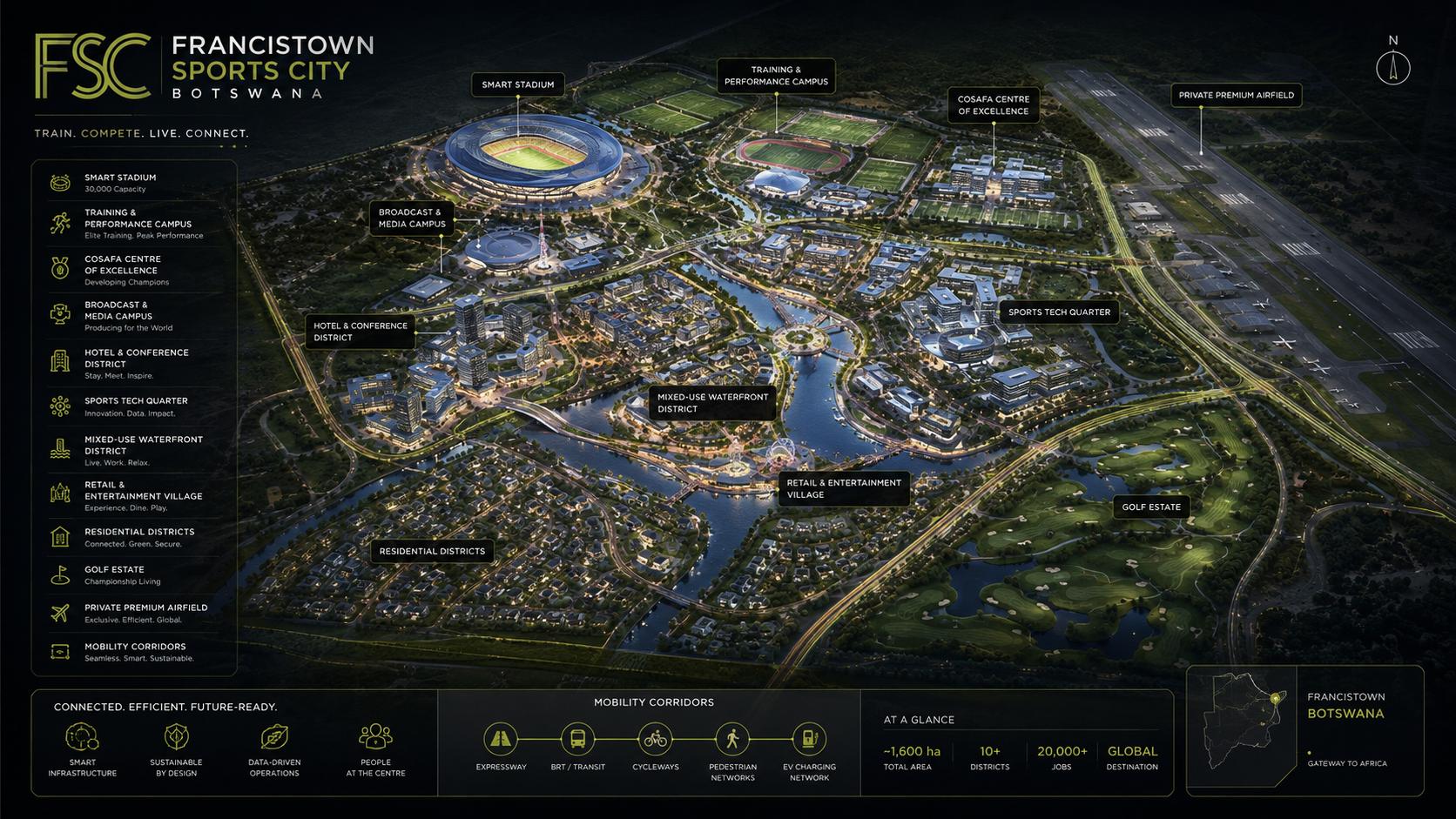
03 · STADIUM & VENUES
The smart-stadium anchor is extended into a full competition ecosystem.
FSC is not a single-venue proposition. It is a structured sports and events system with main-event infrastructure, training clusters, indoor facilities, media operations, athlete services and public participation assets.
Major football, athletics, ceremonies, concerts and regional tournament hosting.
Training pitches, conditioning, athlete services and team preparation environments.
Basketball, netball, combat sports, volleyball, gymnastics and flexible indoor events.
OB integration, content studios, control rooms, commentary and media services.
Coach, referee, technical, tactical and elite youth development programmes.
Team hotels, conference venues, premium hospitality and event-support infrastructure.
FootballAthleticsRugbyCricketBasketballNetballTennisAquaticsCyclingEsportsCombat SportsVolleyballPara SportCommunity Sport
04 · PERFORMANCE & TALENT
Build a pathway from grassroots participation to COSAFA and continental competition.
FSC is designed as a major northern talent-development node. It connects schools, district hubs and academies into a structured athlete progression system reinforced by coaching, sports medicine, analytics and match operations capability.
05 · EDUCATION · MEDIA · SCIENCE · TECHNOLOGY
Francistown grows sport and the systems around sport.
FSC's distinct contribution to the wider portfolio is the integration of sporting performance with content production, technical education, sports science, software and operational capability development.
Coaching, administration, hospitality, venue operations and athlete education pathways.
Strength and conditioning, rehabilitation, athlete testing, nutrition and injury prevention.
Live production, commentary, editing, digital storytelling, streaming and studio content.
Analytics, ticketing, fan systems, match operations, data products and smart venue software.
Training for officials, control-room operations, tournament workflows and event integrity.
06 · DISTRICT ECONOMYThe venues generate demand.
The venues generate demand.
The districts monetise it.
FSC is conceived as a year-round destination. The Sports City captures value through its mixed-use waterfront, entertainment, hospitality, commercial and residential districts, supported by a canal network, golf and public realm activation.
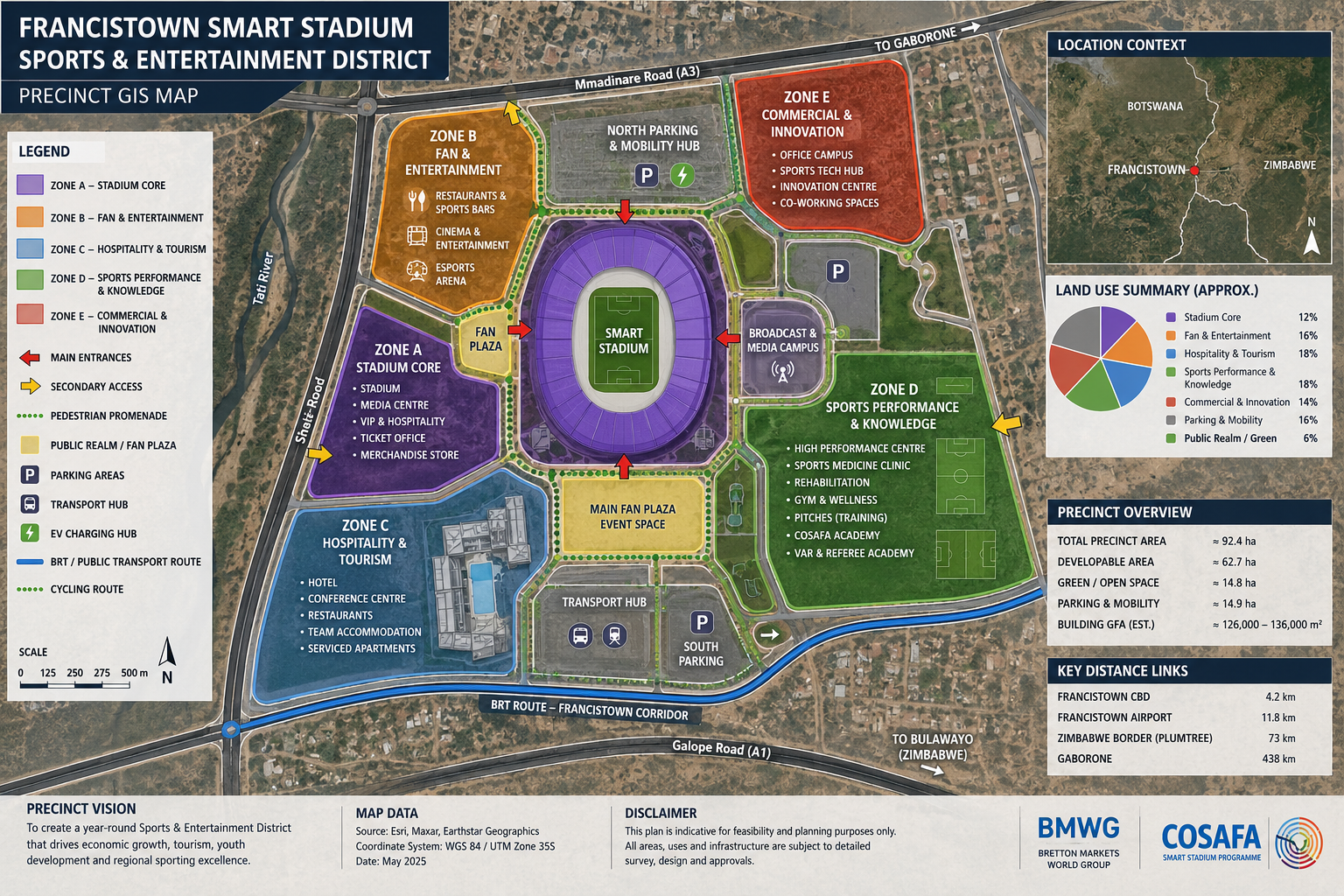 FSC / GIS PRECINCT LOGIC
Retail, promenades, restaurants, public space and water-linked identity.
Fan streets, food halls, sports bars, family entertainment and daily activation.
Team stays, MICE, tournament hospitality and visitor accommodation.
Federations, sports businesses, agencies, sponsors and media-linked enterprise.
Apartments, serviced living, athlete accommodation and mixed-income neighbourhoods.
Golf, club facilities, premium residences, wellness and destination leisure.
07 · MOBILITY & CONNECTIVITYConnect the city to Botswana.
Connect the city to Botswana.
Connect the destination to the region.
FSC's operating model depends on fast, reliable movement of athletes, officials, teams, residents and visitors. It therefore combines local mobility with tournament logistics, road and rail connectivity, premium aviation and event-day circulation systems.
Planned internal spine linking major districts and event nodes.
Flexible public transport and event-day shuttle capacity.
Integration with Francistown's broader transport and logistics role.
Leisure mobility, waterfront access and internal district identity.
Rapid regional access for visitors, executives, media and athletes.
Charter, team, VIP, medical and logistics operations.
08 · REAL ESTATE · TOURISM · LIFESTYLE
A Sports City that performs as a destination district.
Real estate is integral to the FSC business model. It provides both place-making and monetisation through hotel assets, residential communities, sports commerce, leisure and premium lifestyle products.
Event hospitality, team accommodation, business travel and conferences.
Food, sports retail, family uses, public activation and night-time economy.
Mixed-use districts, athlete housing and premium canal-facing residences.
Golf estate, wellness amenities, parks, promenades and destination leisure.
09 · DIGITAL TWIN & SMART STADIUM OPERATIONSOperate the city.
Operate the city.
Operate the stadium.
Operate the tournament.
FSC is intended to be one of the portfolio's leading operational command environments, integrating venue operations, security, ticketing, crowd flow, media production, logistics, utilities and asset performance through a city-scale digital operating model.
Smart Stadium OpsBroadcast ControlTicketingMobility CommandSecurityUtilitiesAsset ManagementFan IntelligenceHospitality OpsDigital Twin
FSC / LIVE OPERATIONS MODELevent readiness · mobility · media · utilities · districts
10 · PHASING & DELIVERY
Deliver the destination in operable commercial layers.
FSC should progress from tournament-readiness infrastructure into a broader mixed-use Sports City. Each phase should unlock capability, visibility and commercial activation while extending the district's long-term value base.
FRANCISTOWN SPORTS CITY / FSCHost. Train. Produce.
Host. Train. Produce.
Connect. Entertain. Thrive.
FSC is the northern gateway expression of Bretton Sports: a smart-stadium-led Sports City that integrates competition, talent development, media, mixed-use districts and destination infrastructure into one regional platform.
SPORTS CITIES / 06MAUN SPORTS CITY
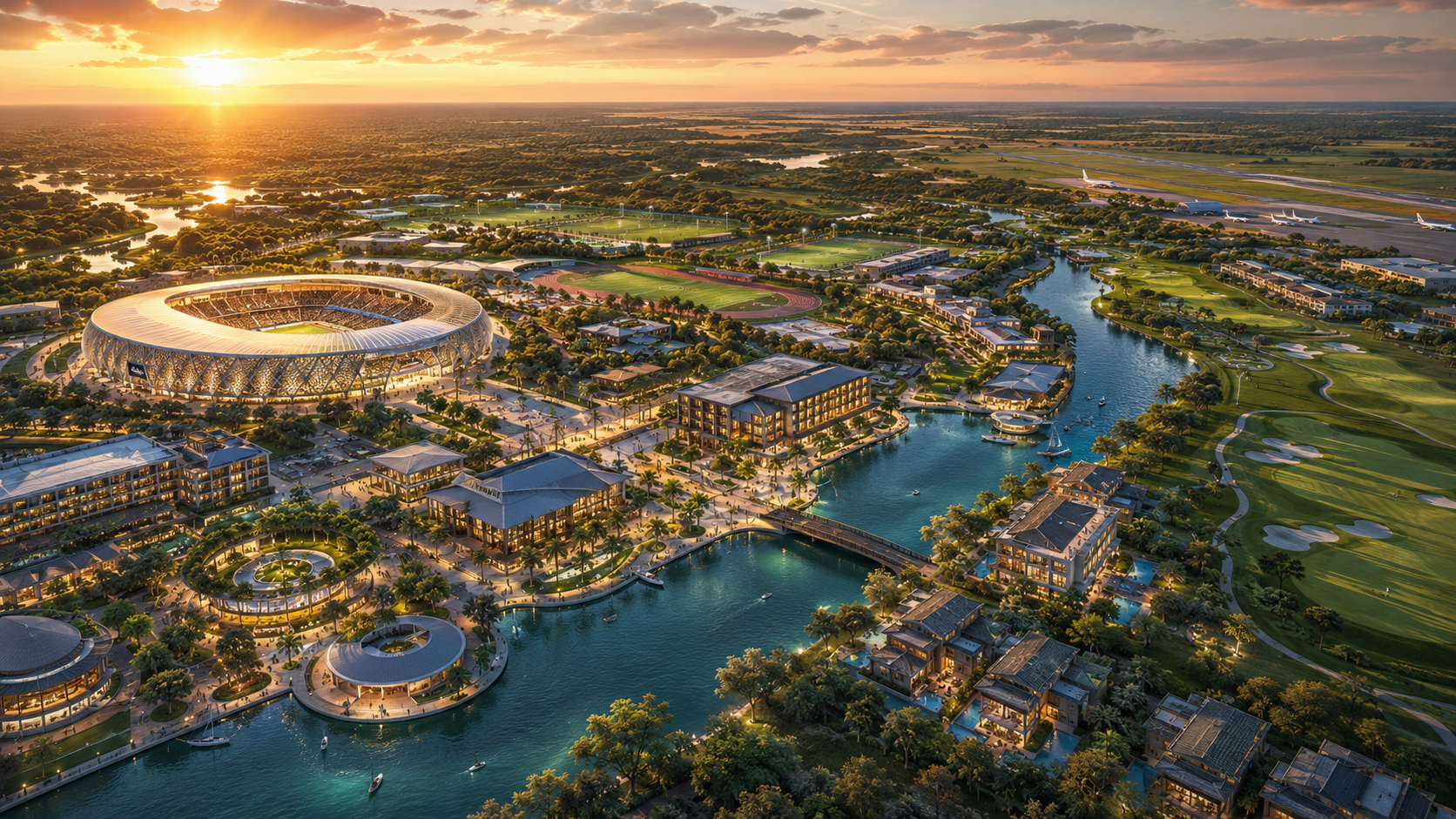
MSC · SPORT × TOURISM × NATURE × WELLNESS
Maun becomes Botswana's sports-tourism, leisure and premium destination city.
MSC is the most destination-driven of the three flagship cities. It integrates sport with Maun's tourism economy, canals and waterfronts, golf estate living, wellness and recovery, eco-luxury hospitality, outdoor adventure, premium aviation and a landscape-led public realm to create a year-round visitor economy.
01 · VISION & POSITIONING
A Sports City built around destination living and visitor experience.
MSC extends the Bretton Sports city model into a premium tourism and lifestyle expression. It is designed to host sport, wellness, recreation, conferencing and branded experiences while capturing value through hospitality, mixed-use districts, golf, residential products and nature-linked mobility.
02 · MASTERPLANOne destination city.
One destination city.
Thirteen integrated systems.
The MSC masterplan applies the same Bretton Sports City OS as GGSC and FSC, but interprets it through Maun's natural landscape, tourism economy and premium destination logic. The resulting city is softer, greener, lower-rise and more resort-like while remaining fully capable of supporting major sporting and commercial functions.
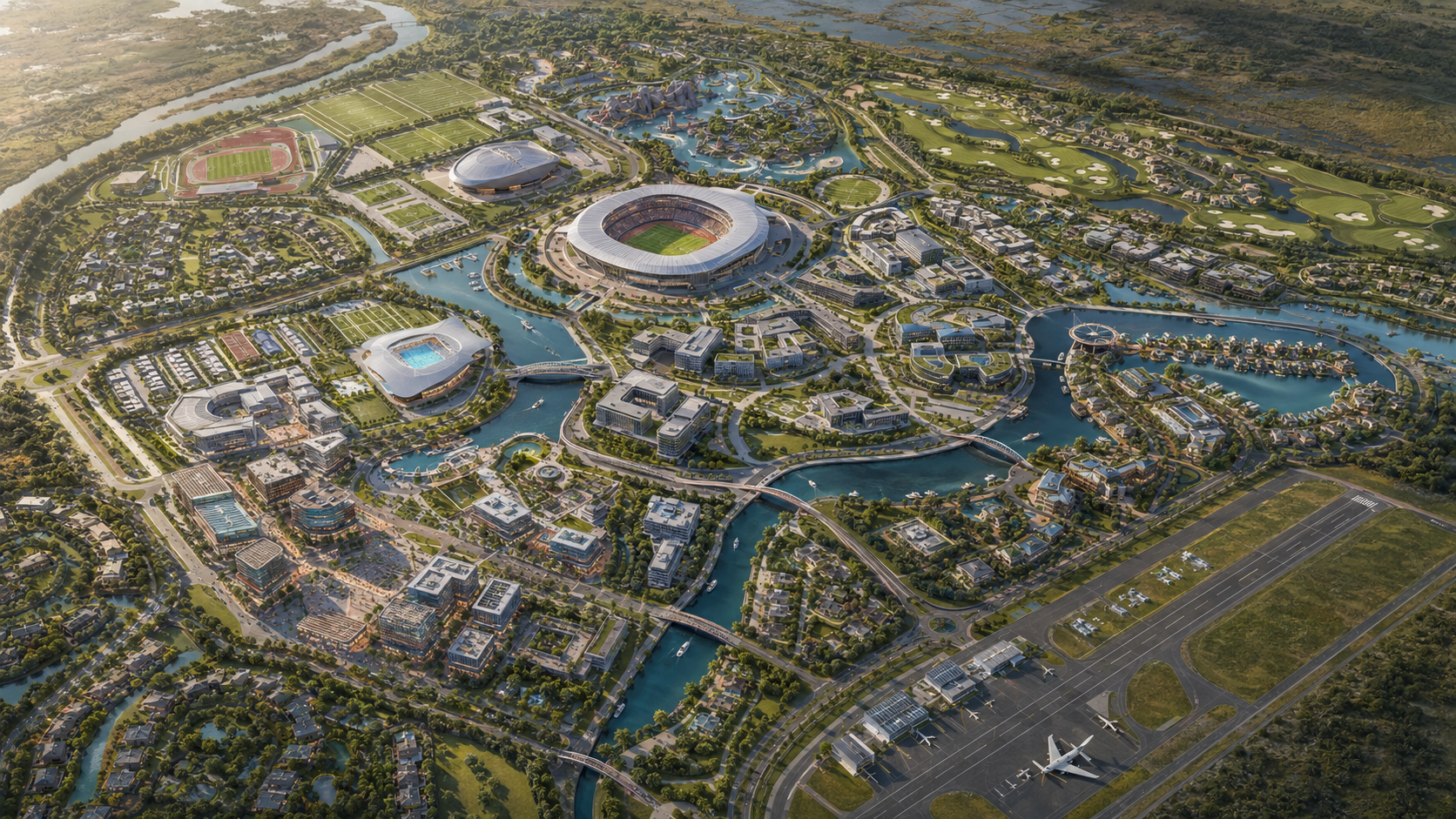
03 · SPORT & DESTINATION VENUESSport is the anchor.
Sport is the anchor.
Experience is the differentiator.
MSC combines major venues with outdoor, leisure and resort-supporting sport assets. Its venue ecosystem supports elite competition and training, but also destination programming, camps, recreation, wellness, corporate retreats and premium lifestyle experiences.
Signature competition, ceremonies, entertainment, festivals and branded visitor events.
Basketball, netball, combat sports, exhibitions, flexible events and indoor entertainment.
Swimming, wellness, aquatic leisure and family destination programming.
Trails, cycling, outdoor training, obstacle experiences and active recreation.
Golf course, academy, club hospitality and premium leisure programming.
Accommodation, conferences, camps, destination weddings and event support.
FootballAthleticsAquaticsTennisGolfCyclingEnduranceAdventure SportBasketballNetballCombat SportsWellnessEsportsCommunity Sport
04 · PERFORMANCE & WELLNESSTrain hard. Recover better.
Train hard. Recover better.
Stay longer.
MSC is optimised for high-performance camps, pre-season programmes, recovery, retreat-style training and sports medicine. The city connects performance infrastructure to wellness and hospitality in a way that supports both athletes and premium visitors.
05 · TOURISM · HOSPITALITY · WELLNESSSport is the reason to come.
Sport is the reason to come.
The destination gives people reasons to stay.
MSC's strongest differentiator is the integration of sport with tourism and premium hospitality. The Sports City is structured to support camps, conferences, festivals, branded experiences, retreat packages, family destination activity and premium visitor spend.
Destination hotels, branded lodges, resort compounds and sports-tourism accommodation.
Retreat programming, medical wellness, rehabilitation and performance recovery.
Corporate retreats, conventions, incentive travel, destination weddings and events.
Restaurants, promenades, water-based recreation and daily visitor activation.
Golf packages, training camps, wellness escapes and sports-luxury itineraries.
06 · MIXED-USE DISTRICTS
Capture value through a 365-day mixed-use destination.
MSC's districts are designed to create all-day and all-year economic activity, with sport generating demand and the surrounding precincts capturing visitor, residential, leisure and commercial value.
Mixed-use promenades, marina-like edges, restaurants, public spaces and destination identity.
Hotels, event spaces, wellness assets and premium tourism services.
Retail village, sports brands, equipment, leisure spend and daily activation.
Canal residences, serviced apartments, resort living and athlete accommodation.
Course-facing residences, clubhouses and golf-driven lifestyle products.
Festivals, fan activity, everyday recreation and community place-making.
07 · MOBILITY & AIRFIELD
Ease of arrival is part of the premium destination proposition.
MSC's mobility system must support both urban function and hospitality-grade convenience. It therefore combines local movement, scenic water mobility, event transport and premium regional access.
Internal movement along the principal destination spine.
Flexible city circulation, employees, residents and event-day movement.
Scenic internal access and signature waterfront mobility.
Rapid access for visitors, executives, athletes and safari-linked transfers.
Charter, executive, team, tourism and medical access infrastructure.
Promenades, running loops, golf-cart movement and resort-scale walkability.
08 · CANALS · NATURE · GOLF
Blue-green infrastructure is both environmental system and lifestyle asset.
The 20-bridge canal network, golf estate and ecological landscape systems give MSC its unique identity. In MSC, nature and real estate are interdependent with sport and hospitality.
Water management, cooling, public realm, scenic mobility and placemaking.
Premium leisure, club amenities, branded homes and visitor spend.
Shaded public space, active living, habitat integration and visitor experience.
Daily recreation, destination image and community activation.
09 · DIGITAL TWIN & DESTINATION OPERATIONSOperate the resort.
Operate the resort.
Operate the venues.
Operate the destination city.
MSC's digital layer synchronises guest experience, venue bookings, mobility, utilities, security, hospitality operations and asset performance. It allows a destination-scale city to function with the precision of a premium resort and the readiness of a smart sporting precinct.
Guest ExperienceVenue BookingsMobilityUtilitiesSecurityWater SystemsHospitality OpsAsset ManagementDestination AnalyticsDigital Twin
MSC / LIVE DESTINATION OPShospitality · venues · canals · mobility · public realm
10 · PHASING & DELIVERY
Build the destination in commercially operable stages.
MSC should be delivered as a layered destination strategy, beginning with anchor sporting and hospitality assets and then scaling into a full premium Sports City.
MAUN SPORTS CITY / MSCPlay. Recover. Explore.
Play. Recover. Explore.
Stay. Connect. Return.
MSC is the tourism and leisure expression of Bretton Sports: a premium Sports City where sport, hospitality, canals, golf, wellness and destination living form one integrated economic platform.
SPORTS CITIES / 07INTEGRATED CITY OPERATING SYSTEM
13 INTEGRATED DEVELOPMENT SYSTEMSOne common City OS.
One common City OS.
Three destination expressions.
Every flagship integrates the same development architecture so sport, knowledge, commerce, leisure, infrastructure and mobility are planned and operated as one urban ecosystem.
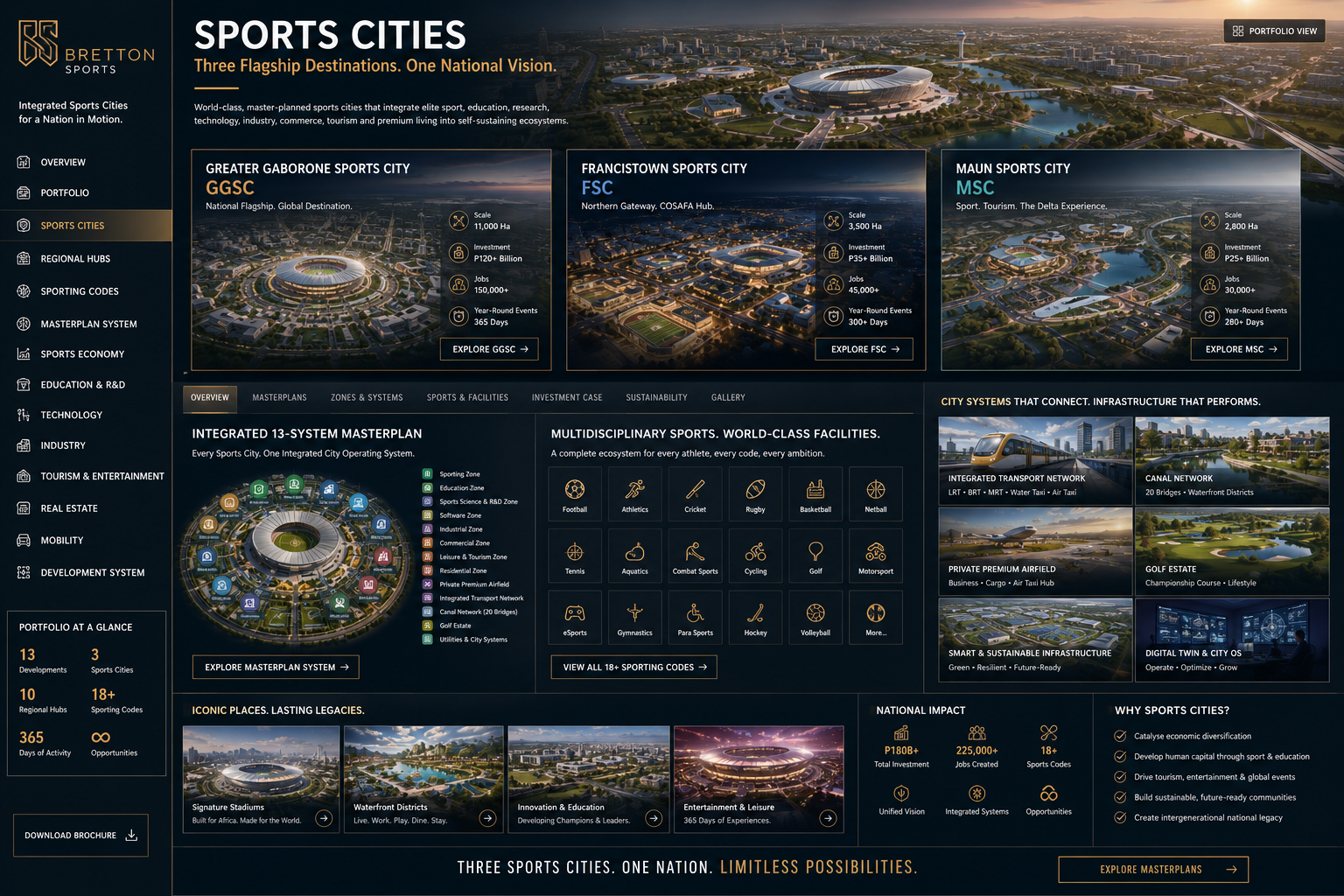 SPORTS CITY OS / INTEGRATED MASTERPLAN + DIGITAL OPERATING MODEL
SPORTS CITIES / 08MULTIDISCIPLINARY SPORTING ASSET SYSTEM
SPORTING ZONE
From community participation to world championships.
The Sporting Zone is a complete hierarchy of major venues, specialist facilities, training environments, public participation spaces and athlete infrastructure.
Smart stadiums, arenas, aquatics, athletics and code-specific competition venues.
Strength & conditioning, biomechanics, recovery, sports medicine and athlete services.
Football, athletics, rugby, cricket, tennis, aquatics, basketball and specialist code academies.
Public pitches, courts, trails, recreation, school sport and participation infrastructure.
Basketball, netball, combat sport, gymnastics, volleyball, esports and flexible arenas.
Cycling, endurance, golf, water sport, motorsport and destination-specific disciplines.
SPORTS CITIES / 09EDUCATION · SCIENCE · SOFTWARE · INDUSTRY
THE KNOWLEDGE ECONOMYDevelop athletes.
Develop athletes.
Develop technology.
Develop industries.
The Sports Cities deliberately connect athlete development to universities, sports science, software engineering, data, research and sports manufacturing so knowledge production becomes part of the city economy.
SPORTS CITIES / 10MIXED-USE DISTRICT ECONOMY
THE 365-DAY CITYThe venues create demand.
The venues create demand.
The districts capture value.
Commercial, hospitality, leisure, residential, golf and waterfront districts keep each city economically active outside match and tournament days.
Offices, sports businesses, retail villages, sponsorship activation, food halls and commercial services.
Hotels, conference centres, restaurants, nightlife, family entertainment and visitor attractions.
Athlete villages, apartments, serviced residences, waterfront homes and long-duration mixed-use communities.
Golf course, clubhouse, academy, residences, hospitality and premium leisure experiences.
Water taxis, boardwalks, bridges, public realm, restaurants and destination identity.
Pedestrian boulevards, civic landscapes, festivals, fan zones and daily public life.
SPORTS CITIES / 11INTEGRATED TRANSPORT + PREMIUM AVIATION
MOVE PEOPLE · EVENTS · TEAMS · VISITORSMass transit for the city.
Mass transit for the city.
Premium mobility for the destination.
Each flagship integrates mass transit with active travel, water mobility, event logistics and a Private Premium Airfield supporting teams, executives, charter, air taxi and medical access.
Executive, team, charter, medical and premium visitor access.
Waterfront districts, water mobility, public realm and destination identity.
Rail, BRT, parking, ride-hailing, cycling and event-day interchange.
Integrated ticketing, demand forecasting, traffic command and event logistics.
SPORTS CITIES / 12DIGITAL TWIN + SMART CITY OPERATIONS
CITY COMMANDPhysical city.
Physical city.
Digital city.
One operating environment.
A Sports City digital twin connects venue operations, utilities, mobility, public safety, ticketing, visitor flows, maintenance, commercial performance and event readiness into an executive command environment.
Venue OperationsMobility CommandUtilitiesPublic SafetyAsset ManagementEvent ReadinessFan IntelligenceCommercial AnalyticsCybersecurityDigital Twin
SPORTS CITIES / 13SUSTAINABLE CITY INFRASTRUCTURE
ENERGYDistributed Clean Energy
Solar, storage, smart grids, efficient venue systems and resilient backup power.
WATERCircular Water Systems
Recycling, irrigation, canal management, smart metering and landscape resilience.
LANDSCAPEGreen & Blue Networks
Canals, parks, shaded public realm, biodiversity corridors and walkable districts.
MOBILITYLow-Carbon Transport
Rail, BRT, active mobility, electric fleets, EV charging and shared transport.
BUILDINGSHigh-Performance Assets
Efficient envelopes, smart controls, lifecycle management and adaptable mixed-use buildings.
OPERATIONSMeasured Performance
Digital metering, carbon and resource dashboards, predictive maintenance and reporting.
SPORTS CITIES / 14DEVELOPMENT & DELIVERY ROADMAP
BUILD THE DESTINATION IN CONTROLLED WAVESAnchor sport first.
Anchor sport first.
Then compound the city economy.
Each flagship can be phased around early sporting and enabling infrastructure, followed by knowledge, commercial, hospitality, residential and mature destination districts.
SPORTS CITIES / 15SPORTS CITY ECONOMY
FROM EVENT VENUE TO ECONOMIC PLATFORMThe stadium creates attention.
The stadium creates attention.
The city captures value.
The flagship-city model combines event revenue with knowledge, technology, industrial, tourism, hospitality, property and mobility economies to create diversified 365-day cashflow and long-duration urban value.
SPORTS
CITY
EVENTSMEDIAEDUCATIONR&DINDUSTRYTOURISMPROPERTYMOBILITYCITY
COMPETITIONGlobal + Continental + National
TALENTGrassroots → Academy → Elite
KNOWLEDGEEducation + Research + Technology
DESTINATIONTourism + Entertainment + Real Estate
BRETTON SPORTS / FLAGSHIP SPORTS CITIESThree iconic destinations.
Three iconic destinations.
One national sports economy.
The flagship city system now connects directly into the ten Regional Sporting & Entertainment Hubs, extending talent development, participation, events and local sports economies nationwide.
Continue to Regional Hubs →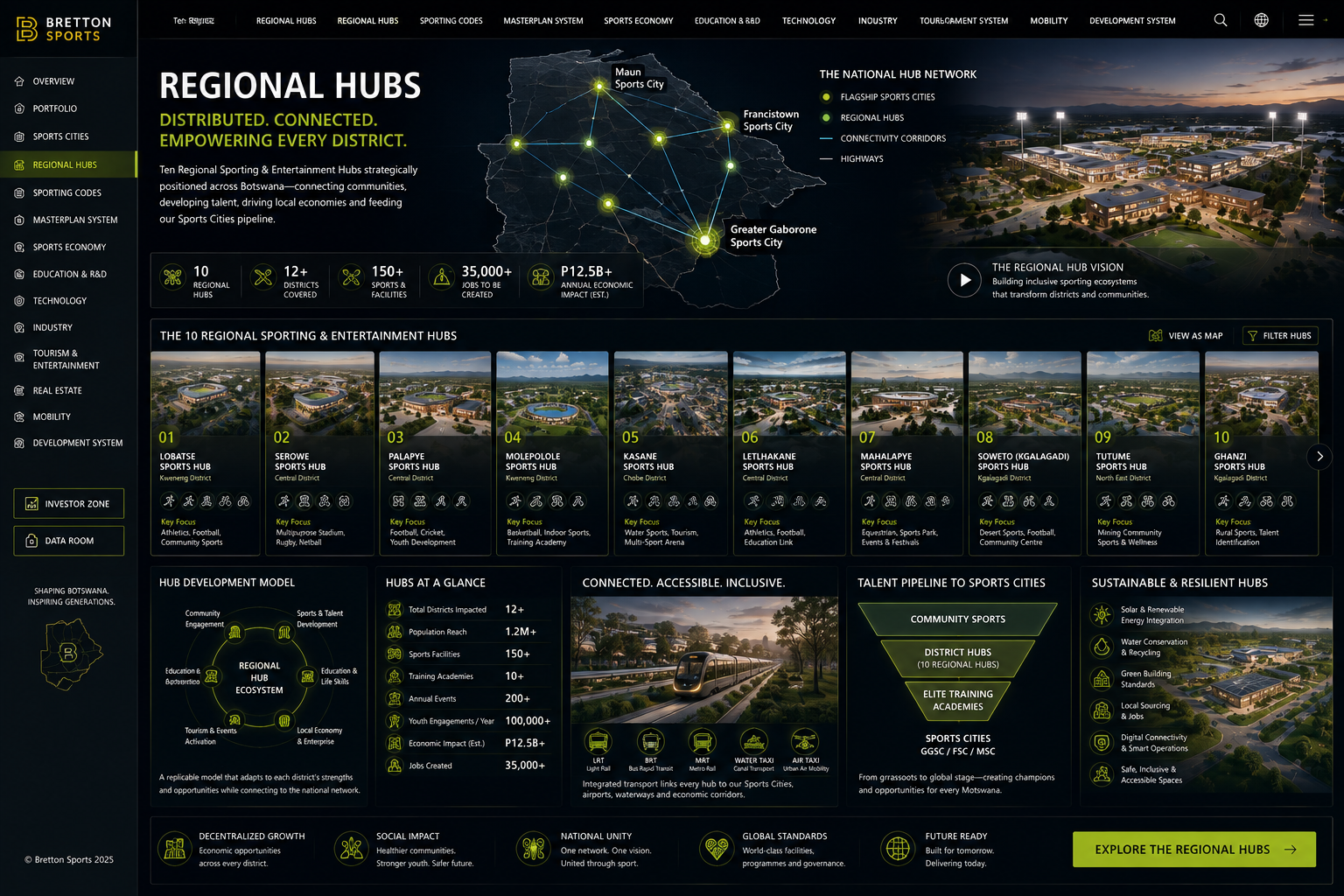
03 · REGIONAL HUBS
Distributed excellence.
Distributed excellence.
National impact.
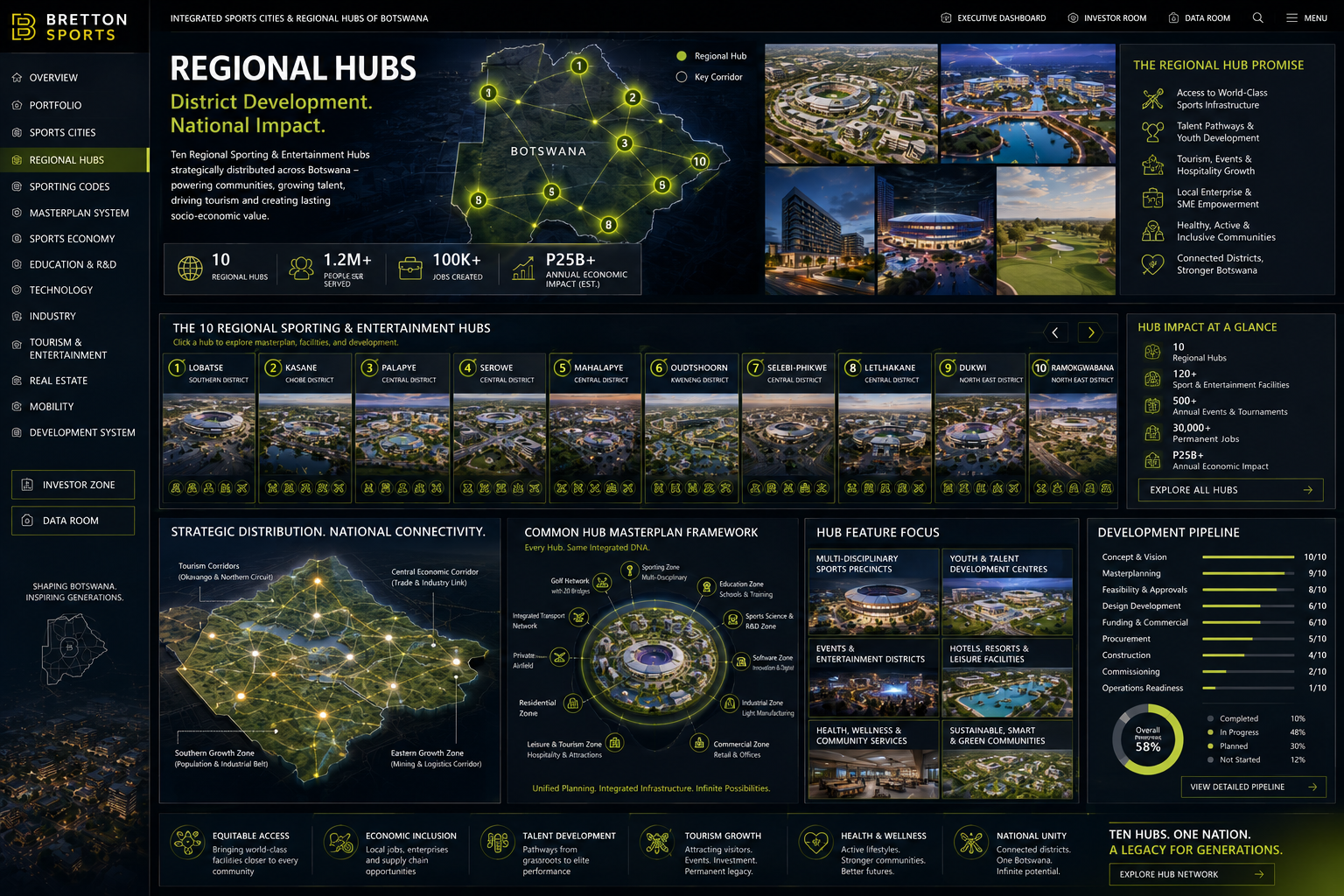
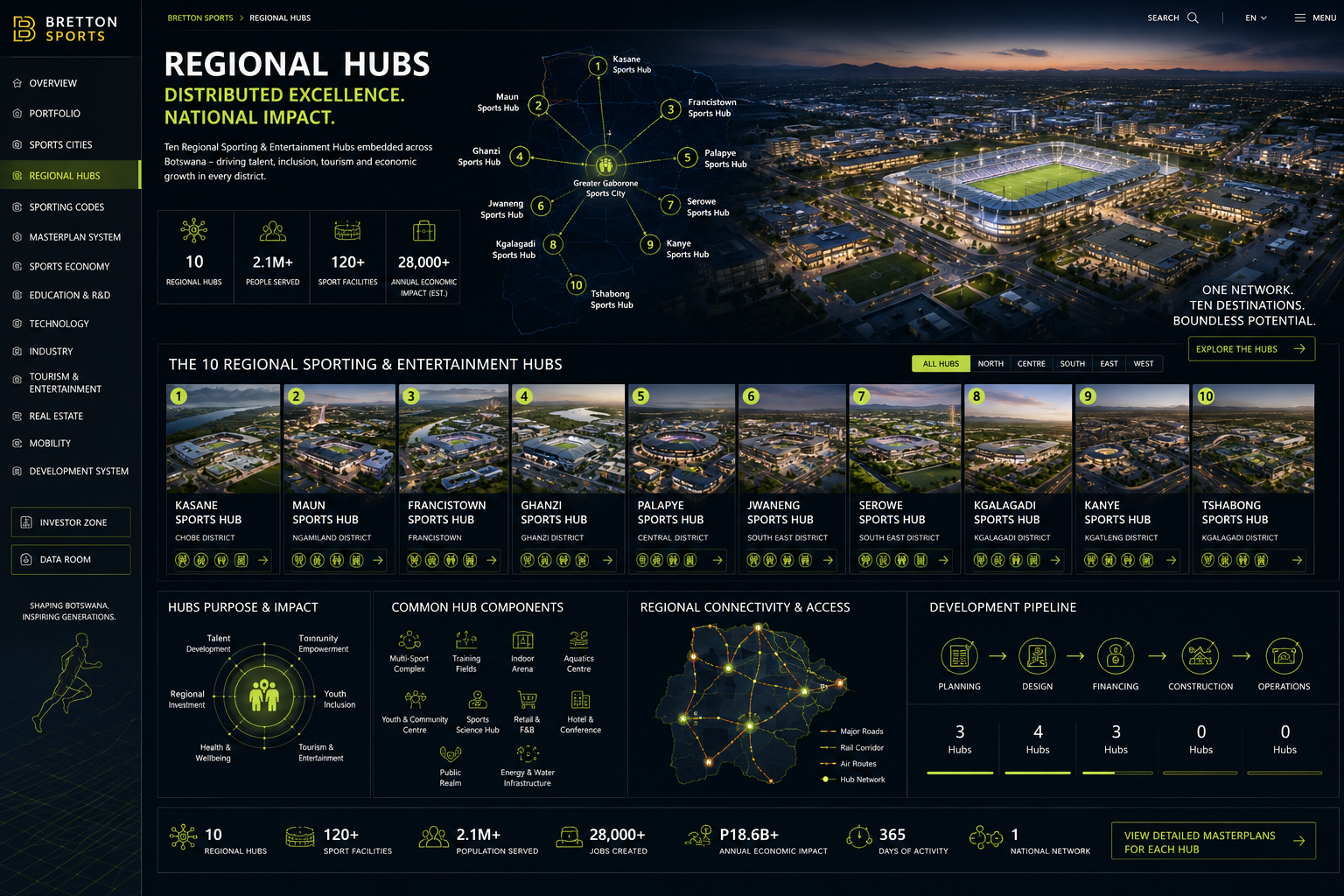
Ten Regional Sporting & Entertainment Hubs extend Bretton Sports beyond the three flagship Sports Cities—bringing multidisciplinary sport, education, training, entertainment, local enterprise and connected community infrastructure closer to every district.
0Regional hubs
0Shared systems
0Sporting codes
365Day activation model
REGIONAL HUBS / 01THE 10-HUB PORTFOLIO
DISTRICT-SCALE DESTINATIONSTen hubs. Ten local propositions.
Ten hubs. Ten local propositions.
One national standard.
Each hub is calibrated to its catchment, sporting demand, tourism potential, education needs and local economy while using the same Bretton Sports development DNA.
REGIONAL HUBS / 02DEVELOPMENT ARCHETYPES
MODULAR BY DESIGN
Not every district needs the same hub.
Four hub archetypes allow the programme to scale intensity, venue size and commercial mix without compromising the common national operating architecture.
Regional stadium, indoor arena, aquatics, academy and event infrastructure for league and tournament hosting.
Competition · Broadcast · HospitalityTraining fields, high-performance, education, sports science and athlete development as the primary proposition.
Academy · Science · EducationHigh-access multi-code facilities, youth centres, wellness, public realm and community programming.
Participation · Wellness · InclusionSport combined with leisure, hospitality, golf, outdoor activity and destination experiences.
Tourism · Events · LeisureREGIONAL HUBS / 03COMMON HUB OPERATING SYSTEM
13-SYSTEM HUB OS
Every hub. Same integrated DNA.
The flagship-city architecture is compressed into a district-scale masterplan system so sport is always connected to education, science, software, commerce, tourism, residential life and mobility.
REGIONAL HUBS / 04MULTIDISCIPLINARY SPORT
SPORTING COREBuilt for participation.
Built for participation.
Ready for competition.
The sport mix is configured per hub using a common facility catalogue spanning stadium sports, indoor codes, aquatics, specialist disciplines, high-performance and community participation.
REGIONAL HUBS / 05TALENT & HUMAN CAPITAL
GRASSROOTS → ELITE01Community Participation →02District Competition →03Regional Academy →04Elite Performance →05Sports Cities
A national pathway that starts locally.
Regional hubs become the first structured node for athlete identification, coaching, competition, education and progression into GGSC, FSC and MSC.
Sports-linked learning, coaching and professional development.
Testing, injury prevention, rehabilitation and athlete data.
Officials, coaches, media, venue operations, technology and enterprise.
Designed participation pathways across age, gender and ability.
REGIONAL HUBS / 06LOCAL SPORTS ECONOMY
365-DAY ECONOMIC ACTIVATION
Local sport becomes a district economic platform.
The hub model is deliberately mixed-use so economic activity continues outside match days through education, retail, hospitality, events, services, wellness and sports enterprise.
League fixtures, tournaments, festivals, concerts and exhibitions.
Food halls, sports retail, local vendors and market activation.
Hotels, lodges, visitor packages, golf and leisure products.
Academy fees, certifications, coaching and technical programmes.
SMEs, maintenance, events, merchandise and supply-chain participation.
Clinics, gyms, rehabilitation, preventative health and active living.
REGIONAL HUBS / 07CONNECTED NATIONAL NETWORK
DISTRICT → CITY → REGIONConnected locally.
Connected locally.
Integrated nationally.
Each hub links into national roads, public transport, aviation and the flagship Sports Cities. Hub-level mobility is scaled appropriately while remaining interoperable with the broader Bretton Sports network.
BRT / ShuttleRegional BusRail InterfaceActive MobilityAir-Taxi InterfaceEvent Mobility
01
No isolated venues. Every hub must connect into its district, its surrounding communities and the national Sports City network.
REGIONAL HUBS / 08SUSTAINABLE & RESILIENT HUBS
Distributed renewable energy, efficient lighting and smart energy management.
Water-sensitive landscape, rain capture and recycling for pitches and public realm.
Shade, biodiversity, walking, cycling and climate-responsive outdoor space.
Efficient envelopes, modular systems and lifecycle-conscious material strategies.
IoT, asset monitoring, security, maintenance and resource optimisation.
Universal access, women and youth participation and community-centred public space.
REGIONAL HUBS / 09DEVELOPMENT & DELIVERY
CONTROLLED PROGRAMME DELIVERYReplicable architecture.
Replicable architecture.
District-specific execution.
Every hub moves through the same controlled development gates while masterplan scope, venue capacity and commercial mix are tailored to local demand.
PORTFOLIO CONTROL10regional developments
STANDARD13common systems
LIFECYCLE11development gates
OUTCOME1connected national network
REGIONAL HUBS / 10NATIONAL IMPACT
TEN HUBS · ONE NATIONAL LEGACY
Sports infrastructure that changes district economies.
The programme is designed to increase access to quality sport, widen talent pathways, stimulate local enterprise, improve wellness, expand event and visitor economies and strengthen national sporting cohesion.
BRETTON SPORTS / REGIONAL HUB NETWORKWorld-class sport should not be concentrated.
World-class sport should not be concentrated.
It should be connected.
The ten Regional Sporting & Entertainment Hubs complete the national architecture between community sport and the three flagship Sports Cities.
Continue to Sporting Codes →REGIONAL HUBS / 11CENTRAL REGIONAL SPORTING & ENTERTAINMENT HUB
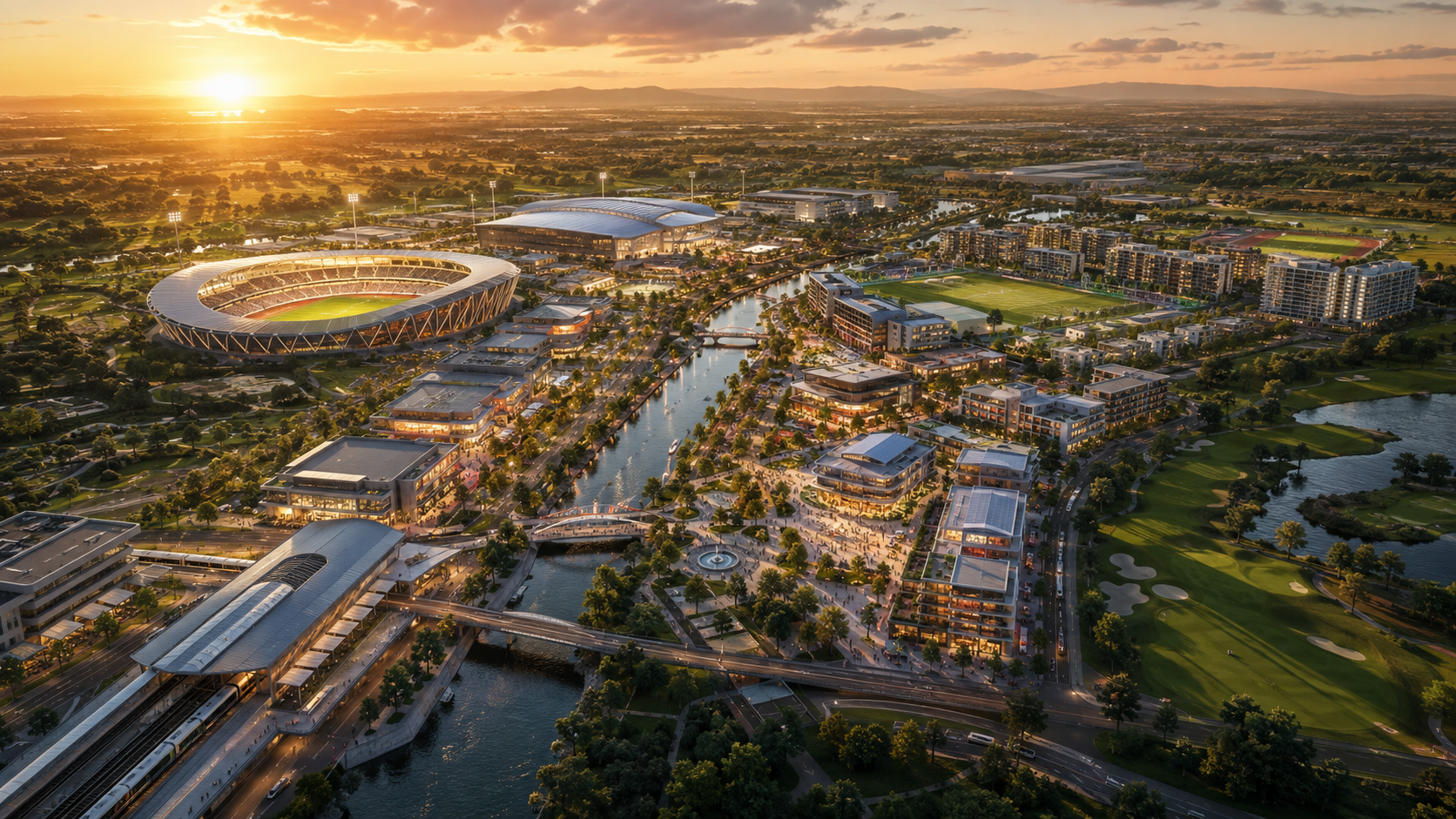
H01 · CENTRAL HUB · COMPETITION + ACADEMY + EVENTS
The Central Hub becomes the district competition, academy and indoor-events anchor of the national network.
Designed to serve the central catchment with high-frequency sport, academy development, indoor events, education, commercial activation and transport-connected accessibility, the Central Regional Sporting & Entertainment Hub is the most scalable and competition-oriented of the ten regional hubs.
01 · VISION & POSITIONING
A regional hub built for high-frequency use and scalable impact.
The Central Hub is conceived as a high-utility sports and entertainment node that can host district competition, year-round training, indoor sport, school and academy activity, exhibitions, conferences and community events. It is less complex than a flagship Sports City, but more intensive and commercially active than a conventional district stadium.
02 · MASTERPLAN & HUB OSCompact, efficient and integrated.
Compact, efficient and integrated.
One regional hub, thirteen systems.
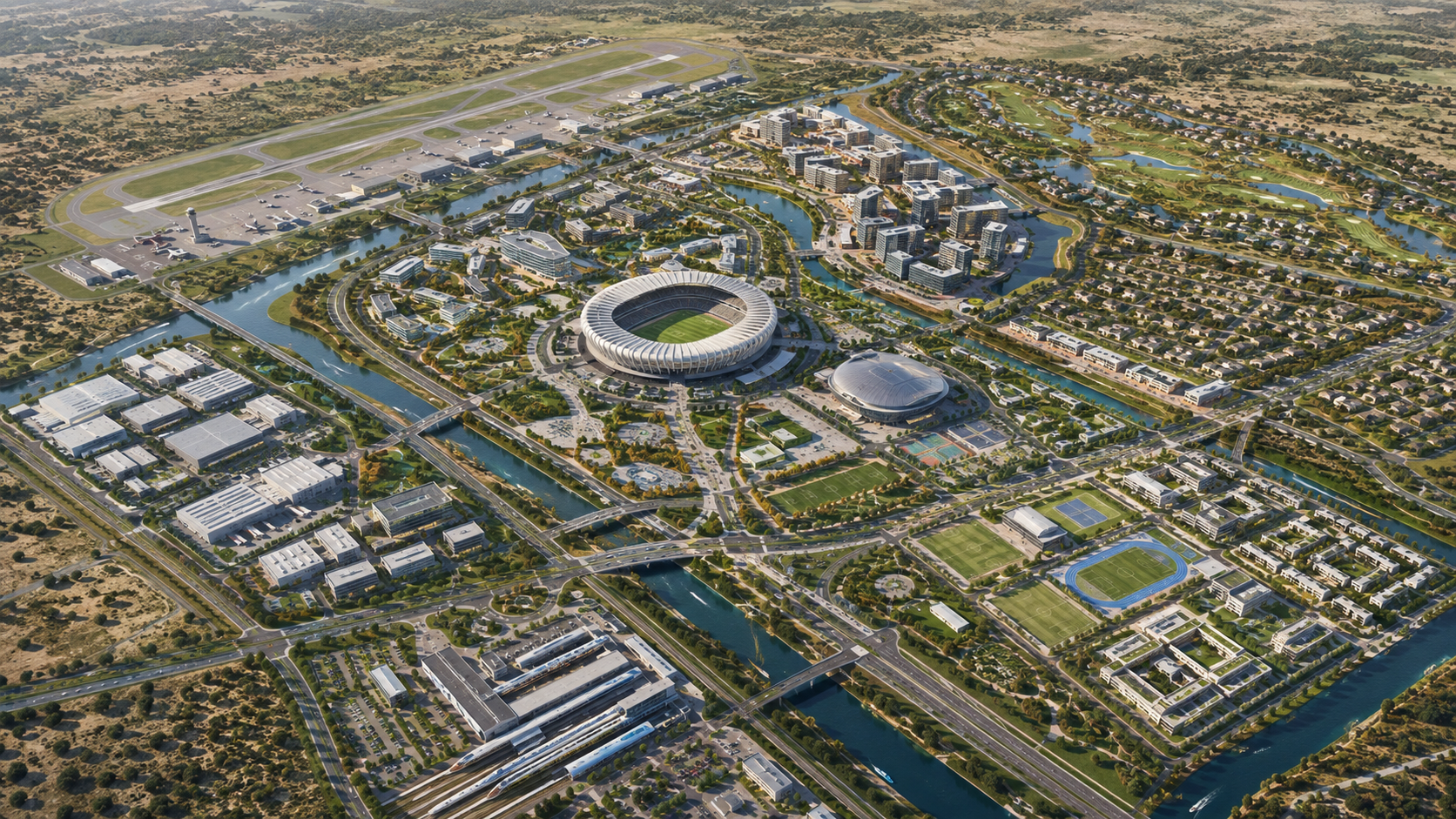
The Central Hub applies the common Bretton Sports masterplan logic at a regional-hub scale. The result is a compact but fully integrated district that combines sport, talent development, commerce, hospitality and public realm in a highly operable layout.
03 · SPORT & EVENT COREMore than one venue.
More than one venue.
A complete regional operating platform.
The venue mix is designed to ensure daily utilisation and strong event flexibility: a competition stadium, indoor arena, academy fields, community facilities, flexible event halls and public-realm spaces that support both sport and entertainment programming.
Football, athletics, ceremonies, district finals and event hosting.
Basketball, netball, volleyball, combat sport, expos and concerts.
Daily training, youth leagues, technical drills and competition warm-up environments.
Open courts, wellness, recreation and broad public access.
Markets, music, community events and district showcases.
F&B, meeting rooms, media, control functions and visitor support.
FootballAthleticsBasketballNetballVolleyballCombat SportsTennisEsportsCommunity SportSchool SportEvents
04 · TALENT & ACADEMY SYSTEM
Build a district pathway that feeds the wider national network.
The Central Hub's academy function is one of its defining roles. It provides a structured environment for youth development, coach education, officiating and athlete progression into GGSC, FSC and MSC as required.
Structured age-grade programmes, seasonal camps and development leagues.
Coach education, referee training and local technical capacity.
Screening, conditioning, recovery and performance monitoring.
Training loads, scheduling, talent records and operational insight.
05 · COMMERCIAL DISTRICTS & SPORTS ECONOMY
Use sport to activate a mixed-use district economy.
The Central Hub is deliberately commercialised. Beyond venue income, it captures retail, F&B, education, events, hospitality, small business services and local employment. This allows the hub to become a district-economy platform rather than a public asset with limited utilisation.
Food, sport retail, services and everyday commercial activity.
Visiting teams, officials, conferences and district events.
Classrooms, sports training, digital learning and youth programmes.
Maintenance, catering, events, merchandise, logistics and micro-enterprise.
Leagues, exhibitions, concerts, festivals and civic gatherings.
Construction, operations, events, sport support and hospitality jobs.
06 · CONNECTIVITY & ACCESS
Simple, efficient movement is critical to high-frequency regional use.
The Central Hub's location and access model should prioritise ease of arrival, low-friction event-day circulation, public transport compatibility and seamless servicing for district users and organisers.
High-capacity movement for event crowds and daily commuting.
Internal distribution and last-mile movement across the precinct.
Simple arrival, coach movement, parking and servicing logistics.
Potential intermodal integration with broader corridor mobility.
Human-scale movement through plazas, streets and public realm.
Teams, officials, service vehicles and operations routing.
07 · DIGITAL HUB OS & COMMANDOperate every venue.
Operate every venue.
Coordinate every event.
See the whole hub.
The Central Hub uses a compact digital operating model integrating venue booking, ticketing, event calendars, security, maintenance, utilities, academy schedules, coach assignments and performance data.
Venue BookingTicketingSecurityUtilitiesAsset ManagementAcademy SchedulingPerformance DataEvent CommandSME ActivationDigital Twin
CENTRAL HUB / LIVE OPERATIONSsport · events · academy · crowd flow · districts
08 · PHASING & DELIVERYDeliver a strong first phase.
Deliver a strong first phase.
Scale through clear operating layers.
The Central Hub should be delivered through disciplined phases that create immediate community utility while progressively expanding competition, academy and commercial capability.
CENTRAL REGIONAL SPORTING & ENTERTAINMENT HUB / H01Compete. Develop. Gather.
Compete. Develop. Gather.
Train. Activate. Grow.
The Central Hub becomes the template for competition-oriented regional hubs within the Bretton Sports portfolio: efficient, commercially active, talent-building and deeply connected to its district economy.
04 · SPORTING CODES
Every code.
Every code.
Every athlete.
One national ecosystem.
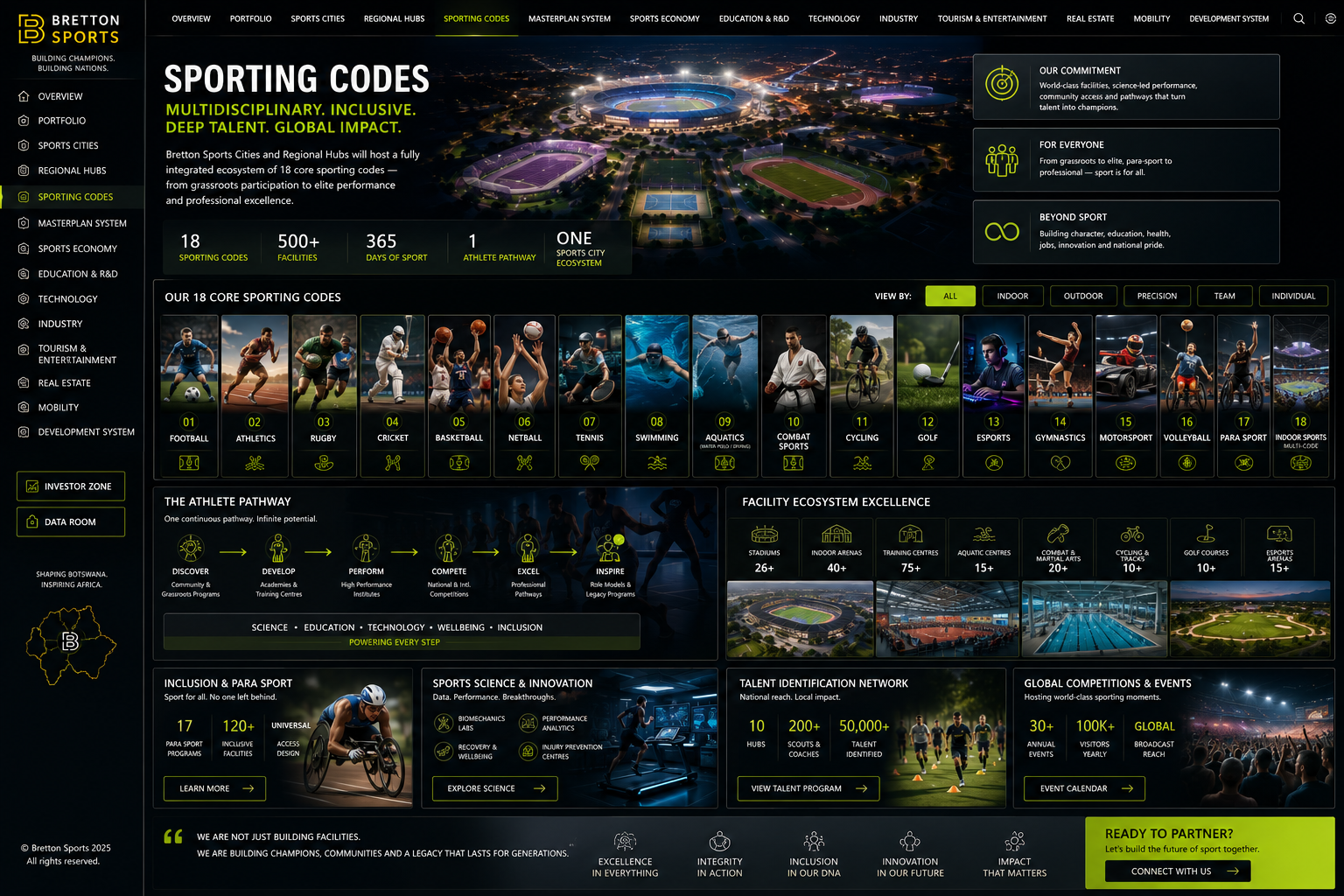
Bretton Sports Cities and Regional Hubs are designed as a complete multidisciplinary sporting platform spanning grassroots participation, talent development, high performance, professional competition, inclusive sport and global events.
0Core sporting codes
0Facilities & venues+
365Days of activation
01Integrated athlete pathway
SPORTING CODES / 0118-CODE PORTFOLIO
MULTIDISCIPLINARY BY DESIGNOne portfolio.
One portfolio.
Eighteen sporting pathways.
The code mix is intentionally broad enough to support mass participation, school and academy development, elite competition, specialist disciplines, para sport and high-value international events.
SPORTING CODES / 02ATHLETE PATHWAY
FROM FIRST TOUCH TO WORLD STAGEA continuous pathway
A continuous pathway
through the entire sporting lifecycle.
The Sports Cities and Regional Hubs are programmed as one connected talent system, allowing an athlete to enter through community sport and progress into academies, high performance, competition and professional pathways without leaving the national ecosystem.
SCIENCEEDUCATIONTECHNOLOGYWELLBEINGINCLUSIONCAREER TRANSITION
SPORTING CODES / 03FACILITY ECOSYSTEM
INFRASTRUCTURE FOR EVERY LEVELCompetition venues.
Competition venues.
Training ecosystems.
Facilities are planned as a hierarchy—from community access infrastructure and training centres through to high-performance institutes and flagship competition venues.
Football · athletics · ceremonies · concerts · international events.
District competition, academies, community sport and events.
Basketball · netball · combat · gymnastics · indoor codes.
Competition pools · training pools · learn-to-swim · recovery.
Multi-pitch academies · schools · clubs · talent development.
Strength · biomechanics · recovery · medicine · analytics.
Championship and lifestyle golf integrated with hospitality and property.
Motorsport · cycling · esports · beach sport · adventure disciplines.
SPORTING CODES / 04HIGH PERFORMANCE
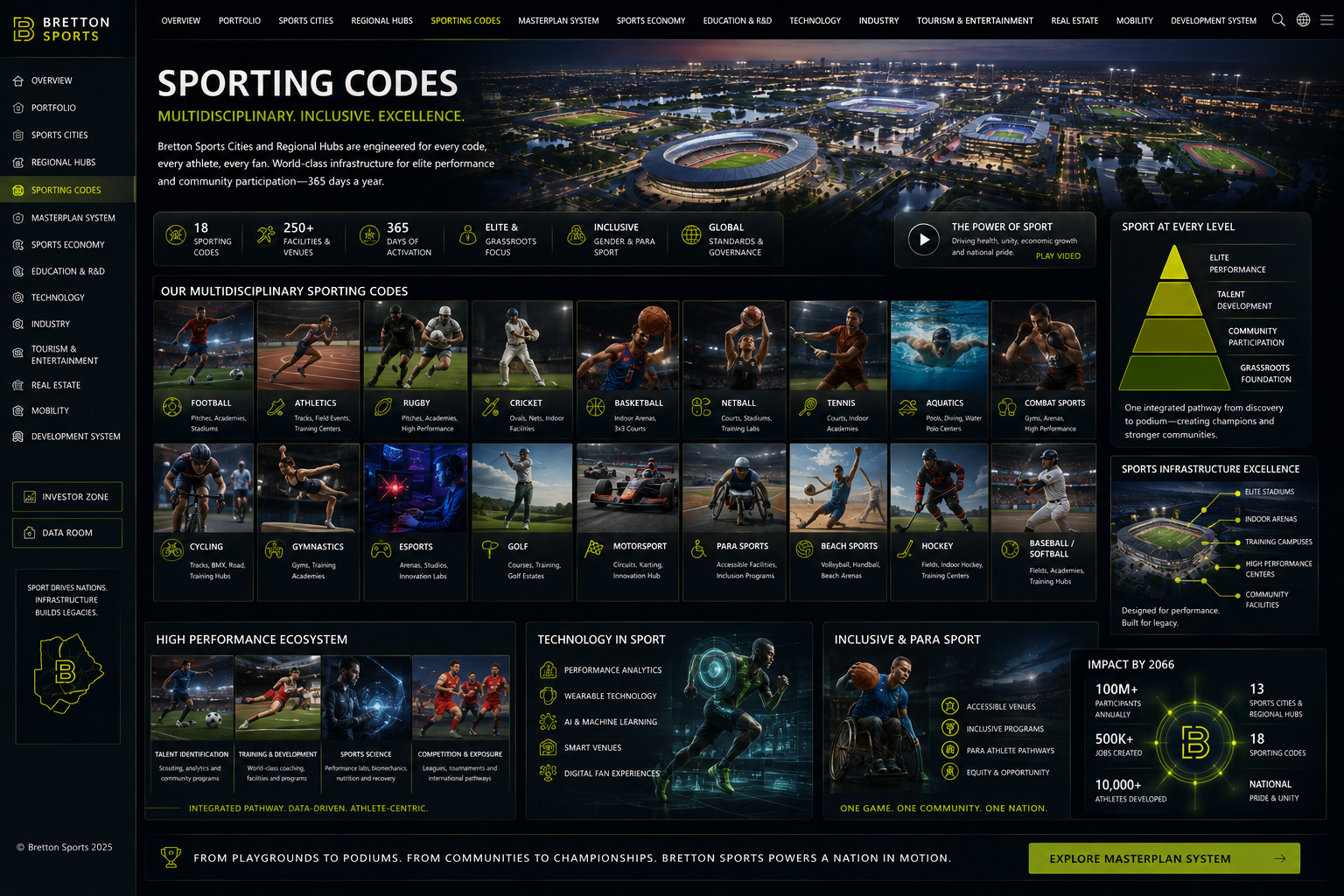
PERFORMANCE ECOSYSTEMBuild athletes.
Talent IdentificationScouting · testing · analytics · athlete profiles Coaching ExcellenceNational curriculum · specialist coaching · certification Performance ScienceBiomechanics · physiology · nutrition · recovery Competition PathwayDomestic leagues · camps · regional & global exposure Athlete ServicesEducation · mental wellbeing · financial and career support Performance DataWearables · video · AI · longitudinal athlete intelligence
Build athletes.
Engineer performance.
Elite sport is supported by an integrated performance stack rather than isolated training venues. The model combines coaching, sports medicine, science, data, competition exposure and athlete wellbeing.
SPORTING CODES / 05INCLUSION & PARA SPORT
SPORT FOR EVERY MOTSWANAUniversal access.
Universal access.
Equal pathways to excellence.
Accessibility is embedded in masterplanning, facility design, coaching programmes, digital systems and competition structures. Para sport is treated as a core sporting pathway, not an add-on.
Universal DesignAccessible SeatingAdaptive EquipmentInclusive CoachingWomen & GirlsYouth AccessCommunity ParticipationPara Athlete Pathways
INCLUSION STANDARD100%
Every Sports City and Regional Hub designed around accessible movement, participation and spectator experiences.
ONE GAME · ONE COMMUNITY · ONE NATIONSPORTING CODES / 06SPORTS SCIENCE & TECHNOLOGY
DATA · PERFORMANCE · BREAKTHROUGHSThe sporting code becomes
The sporting code becomes
a research and innovation platform.
Every major sporting programme connects into the Sports Science & R&D and Software Zones, creating a continuous feedback loop between athletes, coaches, scientists, engineers and digital product teams.
SPORTING CODES / 07COMPETITION & EVENTS
365-DAY SPORTING CALENDARFrom district competition
From district competition
to global sporting moments.
The portfolio is designed to support a dense annual programme: schools and grassroots competitions, academies, national leagues, regional tournaments, international championships, exhibition events and multi-sport festivals.
500+Potential annual sporting activations across the network
13Connected competition destinations
18+Codes available for event programming
365Day destination activation strategy
SPORTING CODES / 08SPORT OPERATING SYSTEM
ONE OPERATING BACKBONEEach code operates independently.
Each code operates independently.
The infrastructure works as one system.
A shared digital and operational layer reduces duplication and enables consistent governance, scheduling, athlete services, event management and performance intelligence across the entire portfolio.
SPORTING CODES / 09NATIONAL IMPACT
FROM PLAYGROUNDS TO PODIUMSSport becomes infrastructure
Sport becomes infrastructure
for human development.
The value of the Sporting Codes programme extends beyond medals and events. It is designed to improve participation, health, youth opportunity, education, national pride, tourism, employment and Botswana's international sporting profile.
BRETTON SPORTS / SPORTING CODESBuild the facilities.
Build the facilities.
Build the athletes.
Build the sporting nation.
The Sporting Codes system is the human-performance engine inside every Sports City and Regional Hub.
Continue to Masterplan System →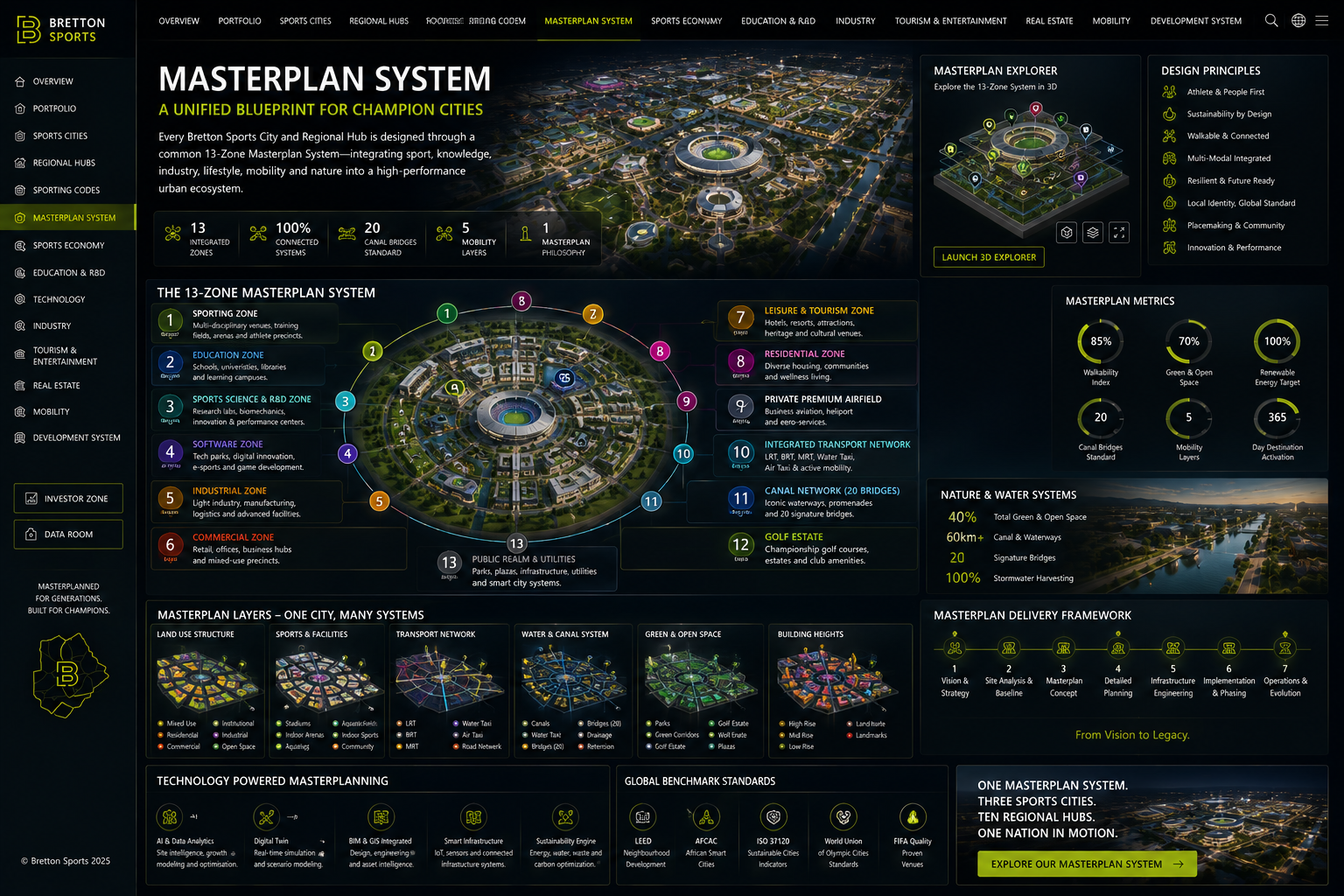
05 · MASTERPLAN SYSTEM
One system.
One system.
Every city.
Every hub.
A repeatable, future-ready masterplanning architecture that integrates multidisciplinary sport, education, science, software, industry, commerce, tourism, residential development, premium aviation, multimodal mobility, canals, golf and public infrastructure.
13Integrated systems
20Canal bridges standard
05Mobility modes
365Day activation philosophy
MASTERPLAN / 01PLANNING PHILOSOPHY
DESIGN PRINCIPLESPlanned for champions.
Planned for champions.
Built for communities.
The Bretton Sports planning model treats sport as the urban anchor for a connected mixed-use destination. Every project is adapted to local context, but the development logic remains consistent across GGSC, FSC, MSC and the ten regional hubs.
Walkable, accessible and safe public environments designed around athletes, residents, visitors and communities.
Sport is integrated with education, research, enterprise, hospitality, residential and leisure uses for 365-day activity.
Land use, mobility, utilities, digital systems, blue-green infrastructure and public realm are planned as one operating system.
Low-carbon systems, climate-responsive landscape, renewable energy, water reuse and resource efficiency are embedded from concept stage.
Botswana landscape, culture and materials inform destinations engineered to international sports and city-making standards.
The same planning DNA can scale from district hub to flagship global destination without forcing identical development programmes.
MASTERPLAN / 0213-SYSTEM CITY OS
INTEGRATED MASTERPLAN SYSTEMThirteen systems.
Thirteen systems.
One development organism.
Each system is commercially, spatially and operationally connected to the others. The result is a destination that works as a city ecosystem rather than as a collection of isolated precincts.
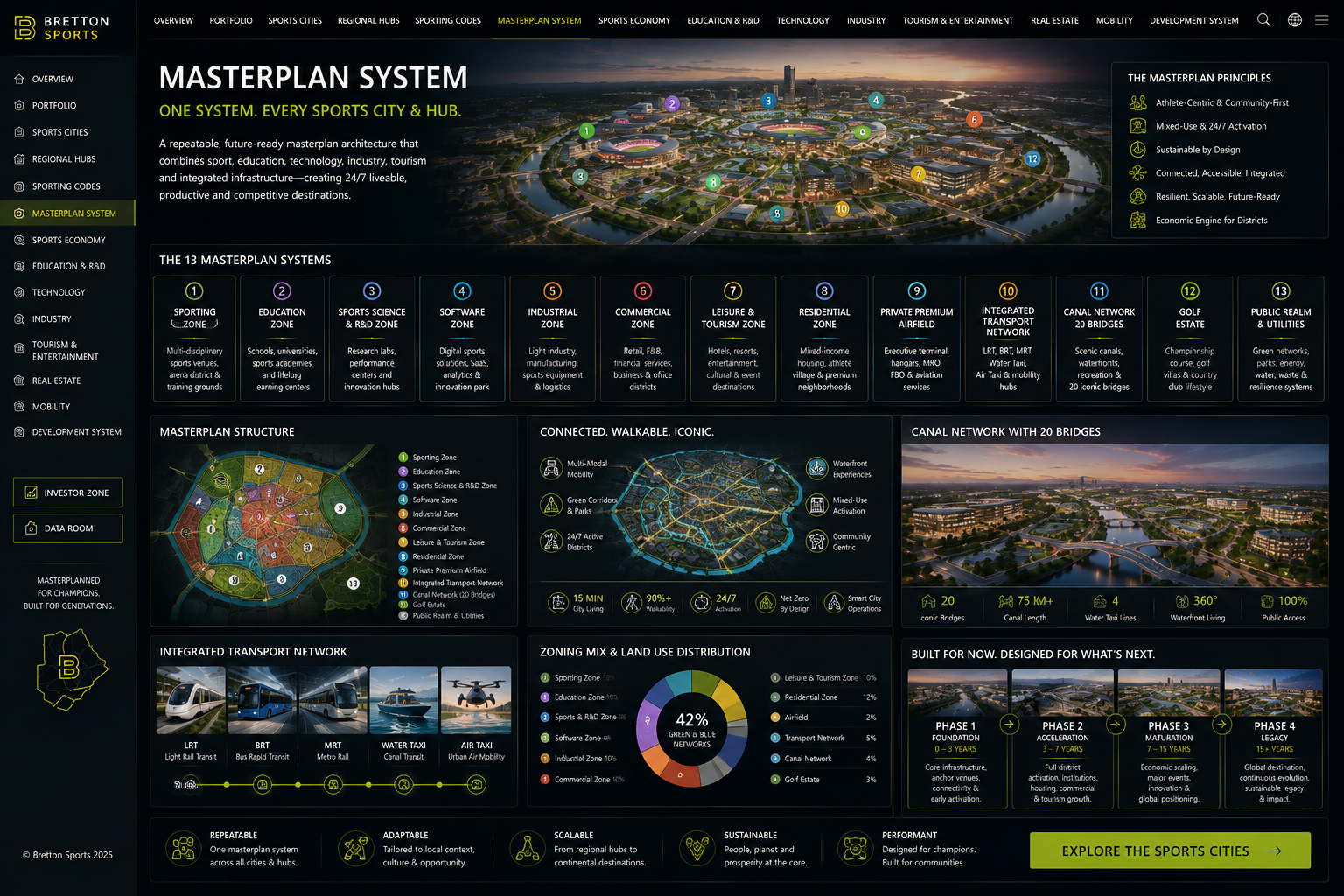 MASTERPLAN SYSTEM / INTEGRATED DEVELOPMENT OS
MASTERPLAN / 03PLANNING LAYERS
ONE CITY · MANY LAYERSEvery masterplan is tested
Every masterplan is tested
as a layered spatial system.
The planning framework moves beyond a conventional land-use plan by testing the interactions between sport, density, mobility, green infrastructure, hydrology, utilities, servicing, public realm and development economics.
SPORTS
CITY CORE
CITY CORE
LAND USE STRUCTURE
A balanced destination economy.
Sporting, education, research, commercial, industrial, hospitality, residential, leisure, aviation and open-space uses are distributed to reinforce accessibility, activation and economic resilience.
Mixed-useWalkablePhasedConnected
MASTERPLAN / 04INTEGRATED MOBILITY
MOVE SEAMLESSLYFive mobility systems.
Five mobility systems.
One connected destination.
The transport hierarchy is planned around high-capacity public transport, first/last-mile movement, pedestrian priority and integrated premium mobility across the complete development.
High-capacity city circulation and regional interchange spine.
Flexible high-frequency corridors connecting districts and event nodes.
Long-term mass transit backbone for flagship Sports Cities.
Waterfront mobility linking leisure, hospitality and destination districts.
Premium point-to-point mobility connected to the private airfield and vertiports.
SPORTS CITY MOBILITY SPINE
STADIUM COREEDUCATION + R&DCOMMERCIALHOSPITALITYAIRFIELD
Walking + cycling + autonomous shuttles provide the neighbourhood-scale layer between strategic transport modes.
MASTERPLAN / 05CANAL + BLUE-GREEN NETWORK
20-BRIDGE CANAL STANDARDWater becomes
20Signature bridges 04Waterfront district types 360°Public waterfront strategy 100%Integrated with green network
Water becomes
infrastructure, mobility and place.
The canal network is conceived as a connected blue-green system supporting stormwater management, irrigation, recreation, biodiversity, waterfront real estate, water taxi movement and public realm.
WATERFRONT
DISTRICT
DISTRICT
MASTERPLAN / 06LAND USE + DEVELOPMENT MIX
BALANCED URBAN ECONOMYEvery zone has a role.
Every zone has a role.
Every district supports the whole.
Land-use allocation remains flexible at concept stage and is calibrated by project scale, location, market demand, environmental constraints and the sporting programme.
13Systems
MASTERPLAN / 07DIGITAL TWIN + CITY INTELLIGENCE
DIGITAL MASTERPLANPlan it digitally.
GISLand · environment · mobility · catchments BIMBuildings · infrastructure · quantities · assets DIGITAL TWINSimulation · scenario planning · operational model IoTEnergy · water · movement · environment · venues AIForecasting · optimisation · anomaly detection COMMAND CENTRECitywide operational and executive intelligence
Plan it digitally.
Operate it intelligently.
The physical masterplan is paired with a digital model connecting GIS, BIM, asset information, IoT, mobility data, utilities and operational intelligence across the development lifecycle.
LIVESPORTS CITY DIGITAL TWINLAND · ASSETS · MOBILITY · UTILITIES · EVENTS
MASTERPLAN / 08SUSTAINABILITY + RESILIENCE
PERFORMANCE BY DESIGNLow-carbon.
Low-carbon.
Climate-responsive. Resource-smart.
Sustainability is treated as a masterplanning performance requirement rather than an architectural add-on. Targets are refined through feasibility and detailed design for each project.
MASTERPLAN / 09PHASING + GROWTH
BUILD THE CORE · GROW THE CITYPhased for viability.
Phased for viability.
Designed for long-term evolution.
Each development is structured so early infrastructure creates a functional sporting destination while future phases add economic depth, density and global destination capability.
MASTERPLAN / 10DESIGN + PERFORMANCE STANDARDS
GLOBAL BENCHMARK · BOTSWANA IDENTITYDesigned to compete globally.
Designed to compete globally.
Engineered to belong locally.
Applicable standards and certification pathways will be selected by asset type and project stage. The portal therefore treats standards as a controlled design framework rather than fixed certifications at concept stage.
MASTERPLAN / 11MASTERPLAN DELIVERY FRAMEWORK
FROM LAND TO OPERATING DESTINATIONA controlled planning process
A controlled planning process
from vision to legacy.
The Masterplan System connects directly into Bretton Sports' broader Development System so spatial planning, approvals, engineering, commercial structuring and delivery remain coordinated.
BRETTON SPORTS / MASTERPLAN SYSTEMOne masterplanning DNA.
One masterplanning DNA.
Thirteen developments.
A national sports-city network.
The system creates a common development language while allowing each Sports City and Regional Hub to express its own market, landscape, sporting and cultural identity.
Continue to Sports Economy →06 · SPORTS ECONOMY
Sport is the anchor. The economy is the platform.
Each development is structured to create recurring economic activity beyond event days.
SPORT→SCIENCE→EDUCATION→TECHNOLOGY→INDUSTRY→ENTERTAINMENT→TOURISM→REAL ESTATE→MOBILITY
Event Economy
Competitions, concerts, exhibitions, hospitality and premium experiences.
Knowledge Economy
Education, sports science, R&D, software, analytics and professional training.
Industrial Economy
Sports equipment, apparel, venue technology, media systems and specialist manufacturing.
Property Economy
Commercial, hospitality, leisure, residential, golf and long-duration land-value creation.
07 · DEVELOPMENT SYSTEM
From vision to operating legacy.
A disciplined, repeatable development operating system that converts national strategy into master-planned, bankable, engineered, delivered and continuously optimised Sports Cities and Regional Hubs.
GOVERNANCE & INSTITUTIONAL ARCHITECTUREClear decision rights.
Clear decision rights.
One accountable programme.
The development system separates strategic oversight, programme control and project execution while maintaining a single source of truth for decisions, risk, capital, design, delivery and benefits.
BRETTON SPORTS
DEVELOPMENT OS
Board / ShareholdersExecutive CommitteeProgramme OfficeTechnical CouncilFinance & RiskCommunity & StakeholdersDEVELOPMENT OS
Decision Rights Matrix
DecisionBoardExCoPMOProject
Strategy & policy●●●○
Capital allocation●●○○
Major approvals●○●○
Programme delivery○○●●
Project execution○○●●
Operations & closeout○○○●
Stakeholder System
END-TO-END DEVELOPMENT LIFECYCLEEleven controlled gates.
Eleven controlled gates.
No broken handoffs.
Every development progresses through the same controlled gate architecture. Deliverables, decisions and evidence are progressively matured before capital and construction exposure increases.
GATE 01
Strategy & Opportunity
Define strategic fit, demand, land opportunity, development thesis, stakeholders and initial value proposition.
FEASIBILITY & BANKABILITYProve the project
Prove the project
before scaling the capital.
The Development System integrates market, technical, environmental, commercial, financial, legal and socio-economic evidence into one bankability case.
FEASIBILITY
CASE
MarketTechnicalFinancialCommercialLegalESGSocio-EconomicCASE
Sporting demand, events, visitors, residents, tenants and tourism.
Land, infrastructure, utilities, mobility, venues and constructability.
Revenue stack, leases, concessions, naming rights and services.
CAPEX, OPEX, cash flow, IRR, DSCR, sensitivities and funding plan.
Environmental, social, jobs, inclusion and community outcomes.
Risk allocation, approvals, security package and lender readiness.
CAPITAL MOBILISATIONMatch each asset
Match each asset
to the right capital.
Rather than financing the portfolio as one monolithic transaction, the system packages infrastructure, property, technology and operating assets into investable tranches with distinct risk and return profiles.
BLENDED
CAPITAL
CAPITAL
- Equity & Infrastructure FundsDevelopment / portfolio equity
- DFI & Development DebtInfrastructure / green / social
- Commercial & Project DebtSenior / structured facilities
- Vendor & ECA FinanceTechnology / equipment / systems
- Government / PPP / LandEnabling works / concessions
DESIGN · ENGINEERING · PROCUREMENTStandardise what matters.
Standardise what matters.
Localise what creates value.
Design control, digital engineering and procurement strategy are integrated so each project benefits from portfolio-level standards while responding to local land, climate, market and supply-chain conditions.
Briefs · standards · capacity · performance criteria
Spatial model · coordinated design · quantities · assets
Whole-life value · constructability · optimisation
EPC · design-build · concessions · framework contracts
Supplier development · SMEs · skills · manufacturing
Contracts · guarantees · insurances · mobilisation
CONSTRUCTION & COMMISSIONINGBuild once.
MobiliseSite · logistics · permits →BuildStructures · systems · public realm →IntegrateICT · MEP · transport · venues →TestSystems · safety · performance →HandoverAssets · data · operations
Build once.
Commission for performance.
The delivery layer connects work packages, schedule, cost, quality, HSE, supply chain, testing and operational readiness in one programme-control framework.
DEVELOPMENT CONTROL TOWERSee the portfolio.
PORTFOLIOMaturity · gates · priorities COSTBudget · forecast · commitments SCHEDULEMilestones · critical path RISKExposure · controls · escalation FIELDDrone · CCTV · IoT · inspections DIGITAL TWINAssets · operations · scenarios
See the portfolio.
Intervene before variance compounds.
A real-time executive environment combines GIS, BIM, schedule, cost, risk, procurement, construction evidence, asset data and benefits tracking across all thirteen developments.
RISK · ESG · RESILIENCEDesign risk out.
Design risk out.
Engineer impact in.
Risk and sustainability are embedded in every gate rather than added at the end. The system links strategic, financial, technical, environmental, social and operational exposures to accountable controls.
RISK
CONTROL
StrategicFinancialTechnicalDeliveryEnvironmentalSocialCONTROL
Net-zero pathway · renewable energy · water stewardship · biodiversity · circularity.
Youth · jobs · health · inclusion · accessibility · local enterprise · community value.
Ethics · transparency · controls · audit trail · stakeholder accountability.
STANDARDS & ASSURANCEWorld-class ambition
World-class ambition
requires controlled quality.
A common assurance framework protects performance across design, construction, digital delivery, safety, sustainability, venue operations and lifecycle asset management.
NATIONAL DEVELOPMENT PIPELINEThirteen destinations.
Thirteen destinations.
One portfolio control model.
The pipeline aggregates project maturity without pretending every city or hub is at the same stage. The objective is controlled sequencing, resource prioritisation and continuous portfolio visibility.
GGSCFSCMSCH01H02H03H04H05H06H07H08H09H10
BRETTON SPORTS / DEVELOPMENT SYSTEMBuild assets.
WORLD-CLASS INFRASTRUCTURE TALENT & HUMAN CAPITAL SPORTS ECONOMY STRONGER COMMUNITIES GLOBAL SPORTING PROFILE Return to National Portfolio ↑
Build assets.
Build capability.
Build a sporting legacy.
Success is measured not only by completed projects, but by operating performance, athlete pathways, community access, jobs, enterprise growth, tourism, knowledge creation and durable national value.